Commotio Cordis: Cardiac Arrest from Chest Wall Trauma
A rare but often fatal cause of sudden cardiac arrest – especially in young athletes. This article explains the pathophysiology, risk situations (ball sports, physical education), and the immediate resuscitation algorithm including early defibrillation.

Author: Dr. med. univ. Daniel Pehböck, DESA
Specialist in Anesthesiology and Intensive Care Medicine, AHA-certified ACLS/PALS Instructor, Course Director Simulation Tirol
Reading time approx. 9 min
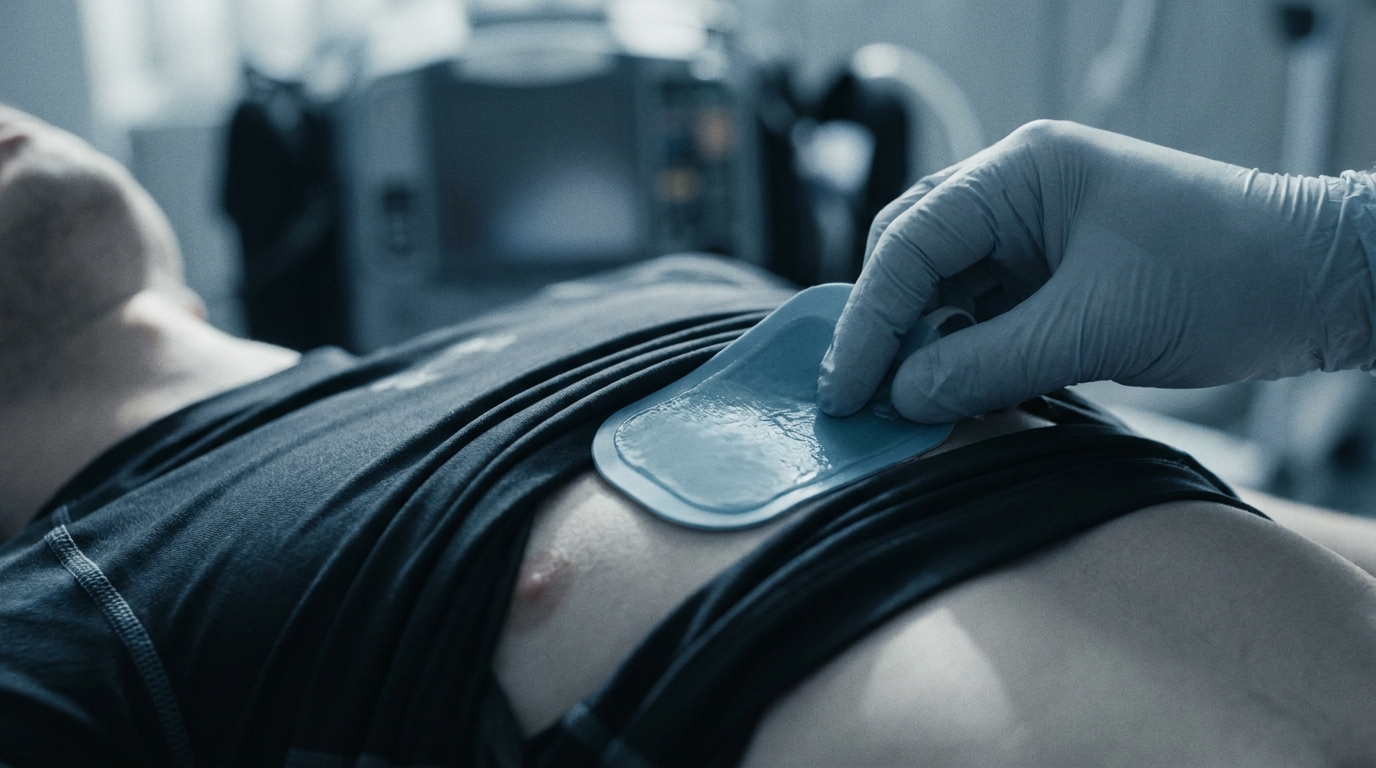
A powerful throw, a hard-hit ball, a puck – and seconds later a young, previously completely healthy athlete lies motionless on the ground. Commotio cordis is one of the most tragic emergency scenarios in sports: a seemingly harmless blunt chest trauma triggers ventricular fibrillation and, left untreated, leads to death within minutes. What makes it so remarkable: there is no structural heart disease, the myocardium is intact, and the triggering impulse would have been completely inconsequential had it occurred at a different fraction of a second in the cardiac cycle. Precisely because commotio cordis primarily affects young, healthy individuals, rapid, algorithm-based intervention is the only factor that determines survival or death.
Definition and Differentiation
The term commotio cordis (Latin for "cardiac concussion") describes a sudden cardiac arrest triggered by a blunt, non-penetrating impact to the chest wall – without any pre-existing cardiac pathology or traumatic myocardial injury. This clearly distinguishes commotio cordis from two related entities:
- Contusio cordis (myocardial contusion): Here, structural myocardial damage is present due to significant force (e.g., steering wheel impact, fall from a great height). Troponin is typically elevated, and echocardiography may reveal wall motion abnormalities.
- Traumatic aortic dissection / pericardial tamponade: High-energy trauma with anatomical destruction of major vessels or the pericardium.
In commotio cordis, all of these features are absent. Autopsy – if resuscitation was unsuccessful – reveals a morphologically unremarkable heart. It is a purely electrophysiological event.
Pathophysiology: The Vulnerable Window
Understanding the pathophysiology is the key to grasping why a relatively minor trauma can trigger a lethal rhythm. The critical factors are:
Timing Within the Cardiac Cycle
The impact must occur within an extremely narrow time window of approximately 20–40 milliseconds before the peak of the T-wave. This window corresponds to the vulnerable phase of repolarization, during which heterogeneous refractory states exist within the ventricular myocardium. A mechanical stimulus at precisely this moment can trigger a reentrant circuit and degenerate into ventricular fibrillation (VF).
Experimental models have shown that impacts occurring outside this window either produce no arrhythmia or only transient premature ventricular complexes or brief complete heart block.
Mechanotransduction
The underlying mechanism is referred to as mechanoelectric coupling. The impact on the chest wall is transmitted directly to the myocardium via the precordium, activating mechanosensitive ion channels (particularly KATP channels and non-selective cation channels). These generate a depolarization current that – if it falls within the vulnerable phase – disrupts the orderly repolarization and initiates a chaotic fibrillation pattern.
Impact Characteristics
Not every chest blow triggers commotio cordis. Experimental data show the following predisposing factors:
- Projectile velocity: Impact velocities between approximately 40 and 70 km/h appear to carry the highest risk. Interestingly, the risk increases again at very high velocities, but then shifts toward contusio cordis with structural damage.
- Object hardness: Harder balls (baseball, lacrosse ball, ice hockey puck) carry a higher risk than softer projectiles.
- Impact location: Directly over the cardiac silhouette, particularly over the left ventricle.
- Impact surface area: Smaller contact areas (such as that of a baseball) concentrate the energy more than large-surface impacts.
Why Mainly Young Athletes?
The clear predominance among children, adolescents, and young adults is explained by the higher compliance of the chest wall in younger years. The not yet fully ossified, more elastic chest wall transmits the mechanical impulse more efficiently to the myocardium than the more rigid adult thorax. Approximately 75% of documented cases involve individuals under 18 years of age, with a peak incidence between 10 and 16 years.
Epidemiology and Risk Situations
Commotio cordis is rare – but after hypertrophic cardiomyopathy and coronary anomalies, it is one of the most common causes of sudden cardiac death in young athletes. The actual incidence is presumably underestimated, as milder forms (transient arrhythmias without cardiac arrest) are not systematically recorded and not every fatal case is correctly classified.
Typical Sports and Scenarios
- Baseball/Softball: The classic setting – a thrown or hit ball strikes the pitcher, catcher, or batter in the precordium. In the United States, baseball is by far the most common cause.
- Ice hockey: Puck impact to the chest, particularly with inadequate protective equipment.
- Lacrosse: Hard ball, high velocities.
- Soccer: Ball kicked against the chest, less commonly collisions with teammates or the goalkeeper.
- Combat sports: Punch or kick to the precordium (karate, taekwondo, boxing).
- Cricket, field hockey, handball: Isolated case reports.
- Non-sports situations: Playful impacts among children, physical altercations, impact against handlebars while cycling.
Sex
The overwhelming majority of documented cases involve male athletes (over 95%). This is likely related to both the higher exposure rate in classic high-risk sports and differences in chest wall configuration.
Clinical Presentation
The clinical picture is dramatic and clear-cut – provided the impact was witnessed:
- Thoracic impact of a projectile or body part against the chest wall
- Brief latency (typically seconds, rarely up to one minute) – the individual may initially still be standing, take a few steps, or display a "stunned" facial expression
- Sudden collapse with loss of consciousness
- No palpable pulse – ventricular fibrillation or (less commonly) ventricular tachycardia
The main challenge in the field is recognizing the cardiac arrest as such. Common misinterpretations:
- "They just had the wind knocked out of them"
- Suspicion of spinal injury in a prone, motionless patient
- Agonal breathing misinterpreted as adequate respiration
- Delay due to the assumption that the player will "get up in a moment"
Any loss of consciousness following chest trauma must be treated as cardiac arrest until proven otherwise. Immediate pulse check (maximum 10 seconds) is critical.
Resuscitation Algorithm: Every Second Counts
Treatment of commotio cordis follows the standard resuscitation algorithm with one crucial emphasis: Early defibrillation is by far the most important survival factor. Since the initial rhythm is ventricular fibrillation in most cases, there is a realistic chance of termination – but only if defibrillation is performed within a few minutes.
Immediate Actions at the Field Side
- Ensure safety – signal to stop play, establish access
- Assess responsiveness – recognize unconsciousness
- Activate emergency medical services (call your local emergency number) – simultaneously send a helper to retrieve the nearest AED
- Pulse check (carotid, maximum 10 seconds) – if uncertain: start CPR immediately
- Begin high-quality chest compressions:
- Rate 100–120/min
- Compression depth at least 5 cm (in adults), but no deeper than 6 cm
- Full chest recoil between compressions
- Minimize interruptions
- Apply AED as soon as available – perform rhythm analysis, deliver shock immediately for VF/pulseless VT
- Resume CPR immediately after the shock – 2-minute cycles, then repeat rhythm analysis
Special Considerations in Young Patients
For children and adolescents, age-adapted guidelines apply:
- Compression depth: Approximately one-third of the anteroposterior chest diameter (approximately 4–5 cm in children)
- AED pads: Use pediatric pads or a dose-reduction system if available. If not available: use standard adult pads – defibrillation with "too much" energy is better than no defibrillation.
- Compression-to-ventilation ratio: 30:2 for a single rescuer, 15:2 for two professional rescuers
Pharmacological Therapy (ACLS Algorithm)
Once intravenous or intraosseous access is established:
- Epinephrine 1 mg IV/IO every 3–5 minutes for persistent cardiac arrest
- After the third unsuccessful shock: Amiodarone 300 mg IV/IO as a bolus, followed by an additional dose of 150 mg for ongoing VF/pulseless VT
- Alternative to amiodarone: Lidocaine 1–1.5 mg/kg IV/IO, repeat with 0.5–0.75 mg/kg
- Reversible causes (Hs and Ts) should be systematically evaluated – in commotio cordis there is no primary correctable cause, but concomitant trauma-related complications (pneumothorax, pericardial tamponade in cases of concurrent contusio) must be ruled out
Prognosis and the Time Factor
Survival rate in commotio cordis correlates directly with time to defibrillation:
- Defibrillation within 1–3 minutes: Survival rate up to 50–70%
- Defibrillation after 3–5 minutes: Survival rate drops significantly
- No defibrillation within 10 minutes: Survival rate below 10%
The overall survival rate has improved markedly with the increasing availability of AEDs at sports fields and athletic facilities. In historical case series, mortality exceeded 85%, whereas more recent registry data report survival rates of 50–60% – a direct effect of AED availability.
Prevention
Prevention of commotio cordis is challenging, as the triggering trauma is nearly impossible to eliminate entirely in many sports. Nevertheless, there are evidence-based approaches:
Protective Equipment
- Chest protectors are recommended for young players in baseball and lacrosse. However, the evidence regarding their actual protective effectiveness is inconclusive – not all commercially available protectors absorb sufficient impact energy to reliably prevent commotio cordis. Standardized testing protocols focusing on the specific impact characteristics are under development.
- Safety baseballs with softer cores have been shown to reduce risk in experimental studies, but are rarely used in competitive play.
AED Availability
The most effective preventive measure against a fatal outcome is not preventing the impact, but rather ensuring widespread availability of AEDs at sports facilities:
- Every sports facility, especially those hosting youth sports, should have at least one immediately accessible AED.
- The AED should be reachable within a maximum of 3 minutes.
- Coaches, staff, and referees should receive regular training in BLS and AED use.
Awareness
Awareness of commotio cordis as a potential cause of collapse following chest trauma must be embedded among coaches, sports medicine physicians, first responders, and emergency teams. Any loss of consciousness following a chest impact is a load-and-go scenario – the temptation to wait and see is the most dangerous mistake.
Differential Diagnoses
In a young athlete with sudden collapse following chest trauma, you should consider the following differential diagnoses alongside commotio cordis:
| Differential Diagnosis | Distinguishing Feature |
|---|---|
| Hypertrophic cardiomyopathy (HCM) | Can occur without trauma; history may include syncope or family history of sudden cardiac death |
| Long QT syndrome / Brugada syndrome | Primary electrical disease, not trauma-associated |
| Myocardial contusion (contusio cordis) | High-energy trauma, troponin elevation, structural damage |
| Tension pneumothorax | Asymmetric breath sounds, jugular venous distension, hemodynamic instability |
| Pericardial tamponade | Beck's triad (muffled heart sounds, hypotension, jugular venous distension), usually higher-energy trauma |
| Vasovagal syncope | Loss of consciousness with preserved pulse, rapid recovery |
In the acute field situation, exact differentiation is secondary – immediate initiation of CPR and defibrillation in the presence of pulselessness takes absolute priority. Etiological classification occurs after return of spontaneous circulation (ROSC) in the hospital.
Post-ROSC Management
Once spontaneous circulation is restored, standard post-cardiac arrest care recommendations apply:
- Targeted temperature management (TTM) per guidelines
- 12-lead ECG – arrhythmias? ST-segment changes?
- Echocardiography – rule out structural damage (contusion? pericardial effusion? valvular injury?)
- Troponin monitoring – differentiation between commotio and contusio
- Neuroprotection and intensive care monitoring
- Cardiac MRI in follow-up – if the morphological findings are unremarkable and the trauma timing is confirmed, the diagnosis of commotio cordis can be established
Survivors of commotio cordis generally have a good long-term prognosis, provided no hypoxic brain injury has occurred. The question of return to play requires an individualized cardiac workup including exclusion of underlying channelopathies or structural heart disease.
Practical Training
Commotio cordis vividly illustrates why structured resuscitation training is essential not only in the in-hospital setting. The ability to immediately recognize a cardiac arrest, perform high-quality chest compressions, and deploy an AED in a time-critical fashion directly determines life or death in this condition. In the ACLS course from Simulation Tirol, you train the entire algorithm – from rhythm recognition to defibrillation to post-ROSC management – in realistic simulation scenarios that replicate exactly these time-critical decision-making situations. Because knowing about the vulnerable phase of the T-wave is of little use if your hands don't automatically do the right thing when it matters.
Want to practice this hands-on?
In our ACLS-Kurs (Advanced Cardiac Life Support) you practice this topic hands-on with high-tech simulators and experienced instructors.
More Articles
Recognizing Agonal Breathing: How to Correctly Interpret Gasping
Agonal breathing is frequently misinterpreted as normal breathing, delaying the start of resuscitation. This article explains its characteristics, how to differentiate it from physiological breathing, and the consequences for first responders and healthcare professionals.
Acute Dyspnea: Differential Diagnosis and Immediate Management
Dyspnea has numerous causes ranging from asthma to heart failure to pulmonary embolism. This article presents a systematic approach to differentiation based on history, clinical examination, auscultation, and point-of-care diagnostics.
Acute Hypoglycemia: Emergency Management in Adults and Children
Threshold values, symptom recognition, oral glucose vs. IV dextrose vs. glucagon – with separate dosing for adult and pediatric patients. A common emergency presentation systematically reviewed.