Cardiac Arrest During Sports: Causes and First Responder Response
Sudden cardiac death in young athletes is rare but devastating. This article covers the most common cardiac causes (HCM, ARVC, channelopathies), warning signs, and the optimal first responder algorithm on the sports field – including AED use and critical time windows.

Author: Dr. med. univ. Daniel Pehböck, DESA
Specialist in Anesthesiology and Intensive Care Medicine, AHA-certified ACLS/PALS Instructor, Course Director Simulation Tirol
Reading time approx. 10 min
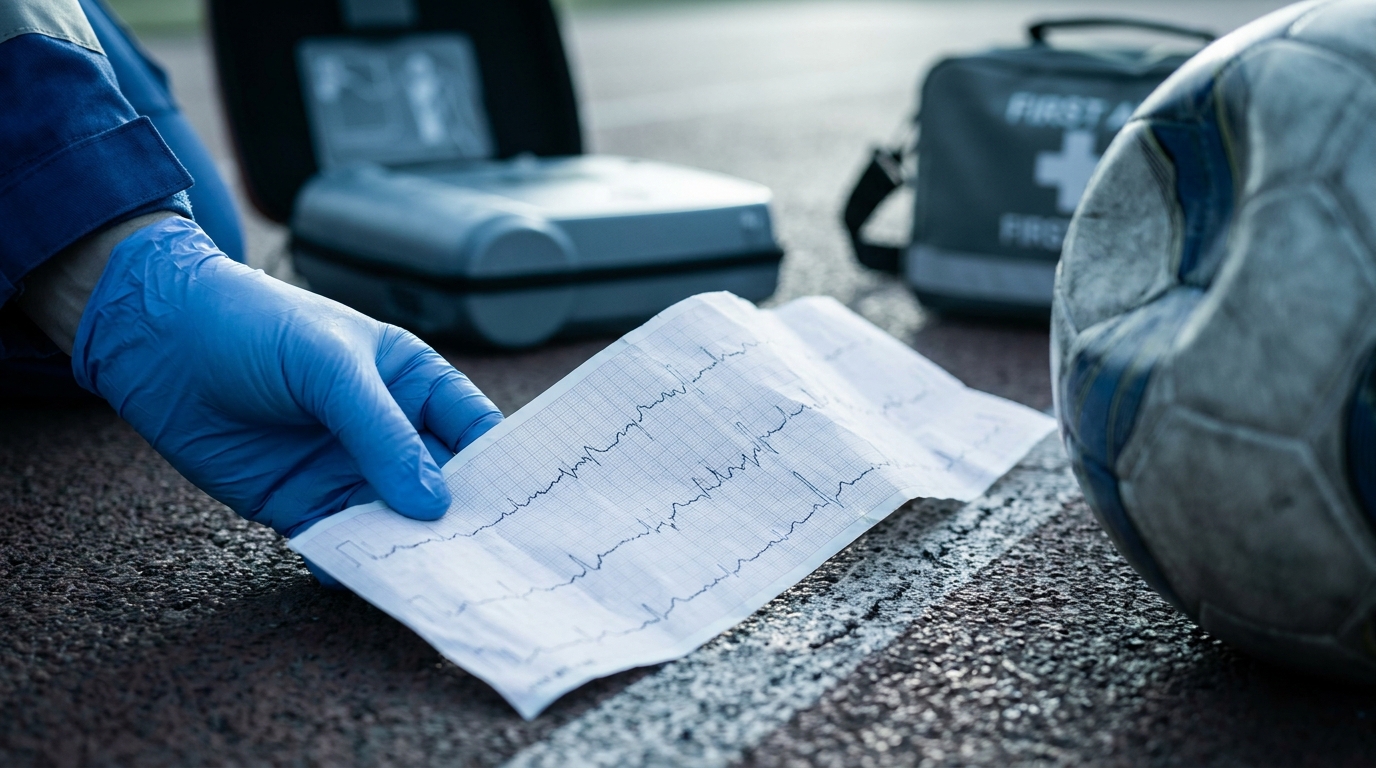
When a seemingly healthy, well-trained person collapses in the middle of a game, it is one of the most shocking emergencies imaginable. Sudden cardiac death during sports primarily affects young competitive athletes in the public perception – but it equally affects recreational athletes on the football pitch, runners at community races, or swimmers during club training. The incidence is statistically low at an estimated 1–3 cases per 100,000 athletes per year, yet each individual case is potentially preventable – at least in terms of survival after the event. Because what matters is not just the underlying pathology, but the speed and quality of the first responder reaction. This article examines the most common cardiac causes, describes warning signs that may be recognizable in advance, and provides you with a clear algorithm for action on the sports field.
Why Sports in Particular? The Paradox of Physical Exertion
Regular physical activity lowers overall cardiovascular risk – that is undisputed. At the same time, intense exertion in the presence of a structural or electrical heart disease can act as a trigger for malignant arrhythmias. This so-called exercise paradox explains why, particularly during maximal exertion – meaning peak sympathoadrenergic activation, catecholamine release, electrolyte shifts, and volume loading – the vulnerable myocardium can tip into a life-threatening arrhythmia.
The underlying pathologies differ significantly by age group:
- Under 35 years: Predominantly congenital structural and electrical heart diseases
- Over 35 years: Dominance of coronary artery disease (CAD) with acute myocardial infarction as the most common cause
For both groups: The initial rhythm in sport-associated cardiac arrest is disproportionately often ventricular fibrillation (VF) – and thus a shockable rhythm. This is prognostically good news, as it means that early AED use can massively improve survival rates.
The Most Common Cardiac Causes in Young Athletes
Hypertrophic Cardiomyopathy (HCM)
HCM is the most common genetically determined heart disease and in many registries the leading cause of sudden cardiac death in young athletes. It is characterized by asymmetric thickening of the left ventricular myocardium – usually the interventricular septum – without an adequate hemodynamic stimulus.
Pathophysiologically, the arrhythmia risk arises from:
- Myocardial disarray (disorganized fiber architecture)
- Interstitial fibrosis as an arrhythmogenic substrate
- Dynamic left ventricular outflow tract obstruction (LVOTO) during exertion
- Diastolic dysfunction with impaired coronary reserve
The challenge: Many affected individuals are asymptomatic and physically fit. HCM is detectable on resting ECG in approximately 75–95% of cases – through pathological Q waves, ST segment changes, or signs of left ventricular hypertrophy. However, a normal resting ECG does not reliably exclude the condition.
Arrhythmogenic Right Ventricular Cardiomyopathy (ARVC)
ARVC is characterized by progressive fibro-fatty replacement of the right ventricular myocardium. Defects in desmosomal proteins (plakophilin-2, desmoglein-2, and others) lead to loss of cell-cell adhesion, particularly under mechanical stress – which explains why intense physical activity can accelerate disease progression.
Clinically relevant:
- Frequently presents initially as ventricular tachycardia or sudden cardiac death during exertion
- ECG clues: Epsilon waves, T-wave inversions in V1–V3, widened QRS complexes in right precordial leads
- In certain regions (e.g., Veneto/Italy), ARVC is the most common cause of sport-associated sudden cardiac death
- Diagnosis according to the revised Task Force criteria (major and minor criteria from imaging, ECG, histology, genetics, family history)
Ion Channel Diseases (Channelopathies)
In so-called primary electrical heart diseases, there is no structural anomaly – the heart appears normal on echocardiography and MRI. The arrhythmia susceptibility arises from genetically determined dysfunction of ion channels that alter the action potential of the cardiomyocyte.
The most important types:
- Long QT Syndrome (LQTS): Prolonged QTc interval with risk of torsades de pointes tachycardia. LQT1 in particular is exertion-associated (especially swimming). Diagnosis via resting ECG (QTc > 470 ms in men, > 480 ms in women as a strong indicator), exercise testing, genetics.
- Brugada Syndrome: Typical ECG changes in V1–V2 (type 1 pattern: coved-type ST elevation ≥ 2 mm with negative T wave). Arrhythmias occur more frequently at rest or during vagal tone but can also occur during exertion.
- Catecholaminergic Polymorphic Ventricular Tachycardia (CPVT): Classically exercise-induced bidirectional or polymorphic VT with a structurally normal heart and normal resting ECG. CPVT is particularly insidious because the resting ECG is often unremarkable and diagnosis is only possible during exercise testing.
Other Causes
- Coronary artery anomalies: Particularly anomalous origin of the left coronary artery from the right sinus of Valsalva with an interarterial course – during exertion, compression and ischemia can occur.
- Myocarditis: Acute viral myocarditis (commonly enteroviruses, parvovirus B19) as an underestimated cause. Exercising during or shortly after an infection massively increases the risk.
- Commotio cordis: Blunt chest trauma (e.g., ball impact, body check) precisely during the vulnerable phase of repolarization (T wave) triggers ventricular fibrillation – even in a structurally completely healthy heart. Typically affects young male athletes in ball sports.
- Aortic dissection in Marfan syndrome: Rare but classic in tall, slender athletes.
Warning Signs: What May Be Noticeable in Advance
Not every sport-associated cardiac arrest comes out of the blue. Retrospective analyses show that a relevant proportion of affected individuals had symptoms in the weeks or months prior – but these were either not investigated or dismissed as harmless.
The following warning signs in athletes should prompt further cardiological evaluation:
- Syncope during exertion – the most important alarm signal. Syncope during (not after) physical exertion should be considered cardiac in origin until proven otherwise.
- Exercise-induced chest pain that cannot be explained by musculoskeletal causes
- Unexplained dyspnea with previously normal exercise tolerance
- Palpitations with dizziness or pre-syncope during exertion
- Sudden cardiac death in the family history (first-degree relatives, especially under 50 years of age)
- Known heart disease in the family (HCM, ARVC, LQTS, Brugada)
The pre-participation sports medical screening – unfortunately not mandatory in a standardized form in Austria – can significantly increase the detection rate of relevant pathologies through a 12-lead resting ECG. The Italian model with mandatory ECG screening has demonstrated that the incidence of sport-associated sudden cardiac death could be significantly reduced.
The First Responder Algorithm on the Sports Field
When an athlete suddenly collapses during exertion, is unresponsive, and shows no normal breathing, action must be taken immediately following the basic life support algorithm. Every second counts – the survival rate decreases by approximately 7–10% per minute without intervention.
Step 1: Safety and Recognition
- Check scene safety (only enter the playing field when play is stopped, no risk from ongoing activity)
- Talk and touch: Call out loudly, shake the shoulders
- Check breathing: Open the airway (head tilt, chin lift), look-listen-feel for a maximum of 10 seconds
- Agonal breathing is not normal breathing – it occurs in up to 40% of cardiac arrests initially and must not be misinterpreted as a sign of intact circulatory function
Step 2: Call for Help
- Call 144 (in Austria) or 112 – ideally through a second person
- Request an AED – loudly and specifically send a named person: "You in the red jersey – get the defibrillator from the clubhouse!"
- If alone: Place the emergency call on speakerphone and immediately begin CPR
Step 3: High-Quality Chest Compressions
- Compression point: Lower half of the sternum, center of the chest
- Compression depth: 5–6 cm
- Rate: 100–120 compressions per minute
- Full recoil of the chest after each compression
- Minimal interruptions: Keep hands-off time as short as possible
- Ratio: 30 compressions : 2 ventilations (for untrained rescuers: continuous compressions without ventilation)
A practical tip: The rhythm of the song "Stayin' Alive" (Bee Gees) corresponds quite closely to 100 beats per minute and can serve as a mental metronome.
Step 4: AED Use – The Decisive Factor
This is the key to survival. In sport-associated cardiac arrest with initial ventricular fibrillation, the survival rate with defibrillation within the first 3–5 minutes rises to 50–70%. Every minute of delay drastically reduces this chance.
AED application:
- Turn on the device (or open the lid – depending on the model)
- Apply adhesive electrode pads to the exposed, dry chest (placement according to the diagram on the pads: one right below the collarbone, one left below the axilla)
- Follow the voice prompts of the device
- During rhythm analysis: Nobody touches the person!
- If a shock is advised: Ensure nobody is touching the person, press the shock button
- Immediately after the shock (or if no shock is advised): Continue CPR – do not wait for signs of life
- After 2 minutes of CPR: Repeat rhythm analysis by the AED
Special considerations on the sports field:
- Sweaty chest: Quickly dry off before applying the pads to ensure good skin contact
- Jersey/sportswear: Cut open or push up – no false modesty
- Dense chest hair (rare in young athletes but relevant in older individuals): If pads don't stick, shave the areas using the razor included in the AED kit
- Wet surface (pitch in the rain): If possible, move the person onto a dry surface, at minimum keep the upper body area dry. Modern AEDs are safe to use in wet environments as long as the pads adhere properly
Step 5: Handover to Emergency Medical Services
- Continue CPR until EMS takes over or the person shows clear signs of life
- Communicate to the EMS team: What happened? When did the collapse occur? How long has resuscitation been ongoing? How many shocks has the AED delivered?
- Leave the AED connected to the patient – the stored data are valuable for further treatment
Commotio Cordis: The Special Case
Commotio cordis deserves special mention because it can occur even in athletes with completely healthy hearts. A blunt impact to the chest wall – typically from a baseball, ice hockey puck, cricket ball, or football – strikes the heart precisely during the vulnerable phase of repolarization (approximately 15–30 ms before the peak of the T wave) and triggers ventricular fibrillation.
Children and adolescents are particularly at risk, as their chest wall is still more elastic and therefore more vulnerable. The survival rate depends almost exclusively on the speed of defibrillation – in commotio cordis, a shockable rhythm is virtually always present.
AED Availability at Sports Facilities
Consistent provision of AEDs at sports facilities is one of the most effective measures for reducing mortality in sport-associated cardiac arrest. International professional societies recommend that an AED should be available within a maximum of 3 minutes' running distance at every sports facility.
In practice, this means:
- Place the AED in a clearly visible, accessible location (not in the groundskeeper's locked office)
- Train all coaches, support staff, and as many club members as possible in AED use
- Regular maintenance and checking of battery and pad expiration dates
- Create emergency action plans: Who calls 144? Who gets the AED? Who begins CPR?
The Chain of Survival
Survival in sport-associated cardiac arrest depends on a seamless chain of survival:
- Early recognition and emergency call – Collapse on the playing field is immediately recognized as an emergency
- Early CPR – Teammates, coaches, or spectators immediately begin chest compressions
- Early defibrillation – AED is deployed within 3–5 minutes
- Early advanced care – EMS and emergency physicians take over ACLS measures
Studies at sports facilities with implemented AED programs and trained first responders show survival rates of over 60% – compared to under 10% in settings without structured first responder programs. The difference lies not in medicine, but in action during the first minutes.
What Often Makes First Responders Hesitate
- "What if I do something wrong?" – In a cardiac arrest, not acting is the only real mistake. Even imperfect CPR is better than no CPR. An AED only delivers a shock when the rhythm is shockable – incorrect treatment by the device is virtually impossible.
- "But the person is still breathing!" – Agonal breathing is not effective breathing. When in doubt: Start CPR.
- "I might break a rib." – Rib fractures can occur during effective CPR and are an acceptable price for survival.
- "I don't have a bag-valve mask." – Hands-only CPR (chest compressions without ventilation) is nearly as effective as CPR with ventilation in the first minutes of witnessed cardiac arrest.
Practical Training
Knowing the theory behind the causes and the algorithm is the first step. But the decisive competence only develops through hands-on practice – learning the correct compression depth, handling an AED under stress, coordinating as a team. In the first aid course at Simulation Tirol, you train these skills in realistic scenarios that closely simulate real emergencies on the sports field. Because the difference between life and death often depends on whether someone acts correctly in the first minutes – and that can be trained.
Want to practice this hands-on?
In our Erste Hilfe Kurs für Firmen you practice this topic hands-on with high-tech simulators and experienced instructors.
More Articles
Automated External Defibrillator: A Guide for First Responders
AEDs are widely available, but many laypeople hesitate to use them. This article explains how they work, correct pad placement, common mistakes, and provides practical tips for training first responders in the workplace.
Electrical Near-Drowning in the Bathtub: Emergency Management
A combination emergency involving electrical injury and submersion in young children in the home environment. This article covers rescue with self-protection, the specifics of resuscitation with concurrent electrical contact and aspiration, and post-event monitoring.
First Aid for Seizures: Positioning, Protection, and Calling Emergency Services
Laypeople and first responders often look for concrete instructions on how to handle epileptic seizures. This article debunks common myths and provides a clear step-by-step guide.