Norepinephrine Infusion Pump Calculation: Dilution and Dosing
Norepinephrine is the central vasopressor in shock management, yet correct dilution and infusion rate calculation regularly causes uncertainty. This article explains common preparations (e.g., 5 mg/50 ml), weight-based dosing in µg/kg/min, conversion to ml/h, and typical dosing errors.

Author: Dr. med. univ. Daniel Pehböck, DESA
Specialist in Anesthesiology and Intensive Care Medicine, AHA-certified ACLS/PALS Instructor, Course Director Simulation Tirol
Reading time approx. 8 min
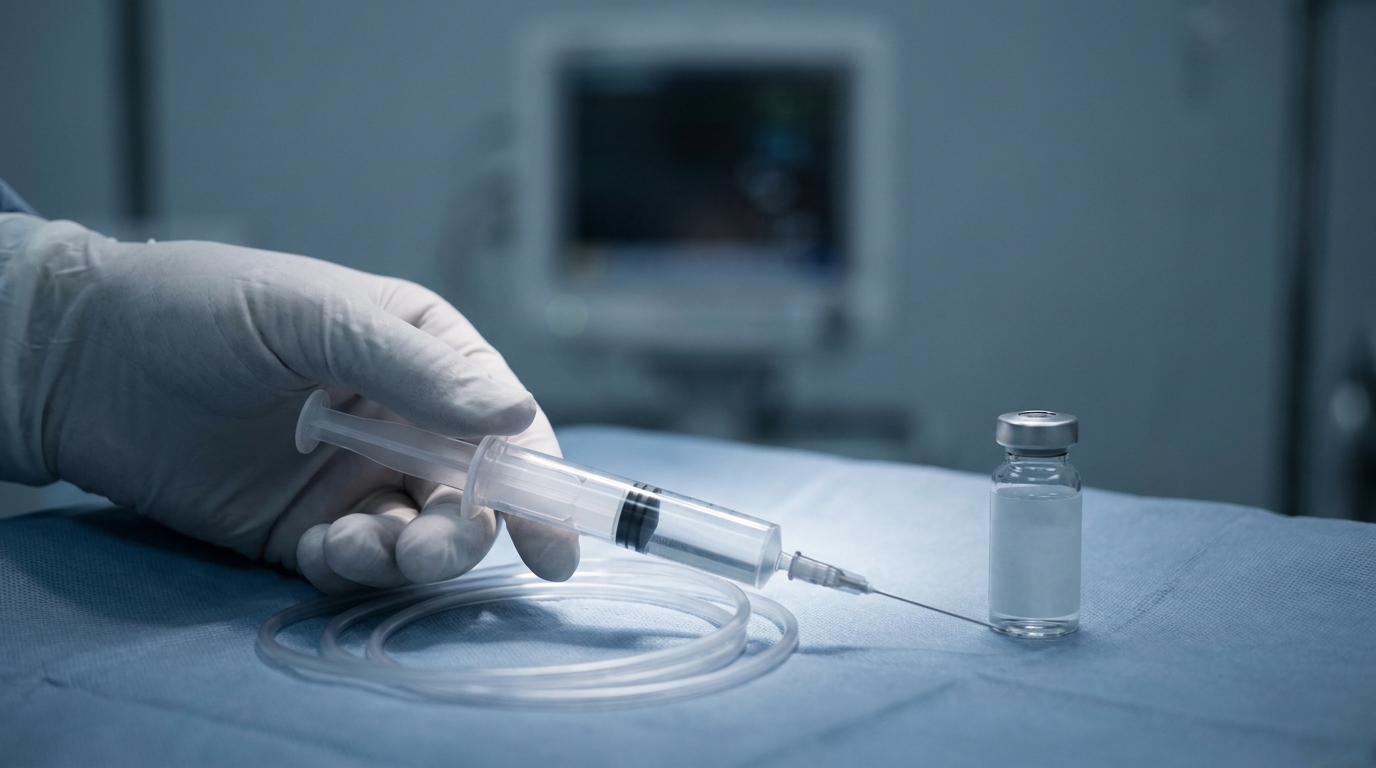
Norepinephrine is an absolute staple in emergency and intensive care medicine. As the first-line vasopressor in distributive shock – particularly in sepsis – it is indispensable in daily clinical practice. Nevertheless, real-world experience consistently shows that correct preparation of the infusion pump, weight-based dosing, and conversion to a concrete infusion rate in ml/h represent a significant source of error. Especially in time-critical situations – resuscitation, septic shock, perioperative hemodynamics – the infusion pump must run quickly and without errors. This article gives you the tools: from pharmacology to common dilutions, concrete calculation examples, and the most frequent pitfalls.
Pharmacological Fundamentals
Norepinephrine (noradrenaline) is an endogenous catecholamine that acts primarily via α₁-adrenoceptors. The result is pronounced arterial vasoconstriction with a consequent increase in systemic vascular resistance (SVR) and mean arterial pressure (MAP). Unlike epinephrine, norepinephrine has only weak β₁ activity and virtually no relevant β₂ activity. This makes it the ideal vasopressor when the primary goal is to restore vascular tone without accepting excessive tachycardia or metabolic side effects (lactate elevation, hyperglycemia).
Pharmacokinetic Key Data
- Onset of action: Within seconds of intravenous administration
- Half-life: Extremely short, approximately 1–2 minutes
- Metabolism: Via COMT (catechol-O-methyltransferase) and MAO (monoamine oxidase), predominantly hepatic
- Elimination: Renal as inactive metabolites
The short half-life is highly clinically relevant: norepinephrine must be administered as a continuous infusion via a syringe pump. Bolus administration leads to uncontrollable blood pressure spikes and is – apart from clearly defined situations such as push-dose vasopressors – not intended.
Indications
- Septic shock: First-line vasopressor after initial volume resuscitation (MAP target ≥ 65 mmHg)
- Distributive shock: Anaphylaxis (adjunct to epinephrine), neurogenic shock, vasodilation under anesthesia
- Cardiogenic shock: In combination with inotropes when SVR is too low
- Post-resuscitation: Hemodynamic stabilization as part of post-cardiac arrest care
Common Dilutions
Various standard dilutions have been established in clinical practice. The choice depends on the clinical situation, the access route, and institutional SOPs. The overarching goal is always the same: a defined concentration that allows simple calculation of the infusion rate.
Standard Dilution: 5 mg in 50 ml
This is by far the most common preparation in the intensive care and emergency medicine setting:
- Preparation: Draw up 5 mg norepinephrine (= 5 ml of a 1 mg/ml solution), dilute to 50 ml with NaCl 0.9% or glucose 5%
- Resulting concentration: 0.1 mg/ml = 100 µg/ml
- Advantage: Simple calculation, broad dosing range at standard infusion rates
Concentrated Dilution: 10 mg in 50 ml
- Preparation: 10 mg norepinephrine in 50 ml total volume
- Resulting concentration: 0.2 mg/ml = 200 µg/ml
- Use: High catecholamine requirements (e.g., refractory septic shock) to reduce volume load and syringe change frequency
Low-Dose Dilution: 2 mg in 50 ml
- Preparation: 2 mg norepinephrine in 50 ml total volume
- Resulting concentration: 0.04 mg/ml = 40 µg/ml
- Use: Pediatric intensive care or situations with very low catecholamine requirements to allow finer titration
Summary Table: Dilutions
| Dilution | Concentration | Typical Use |
|---|---|---|
| 2 mg / 50 ml | 40 µg/ml | Pediatrics, low-dose therapy |
| 5 mg / 50 ml | 100 µg/ml | Standard ICU/emergency |
| 10 mg / 50 ml | 200 µg/ml | High-dose requirements, volume sparing |
The Calculation Step by Step
The weight-based dosing of norepinephrine is expressed in µg/kg/min. The usual dosing range is:
- Starting dose: 0.05–0.1 µg/kg/min
- Therapeutic range: 0.1–1.0 µg/kg/min
- High dose (vasoplegic shock): up to 2.0 µg/kg/min (rarely higher)
The Basic Formula
Conversion from µg/kg/min to ml/h is done using the following formula:
Infusion rate (ml/h) = [Dose (µg/kg/min) × Body weight (kg) × 60] ÷ Concentration (µg/ml)
The factor of 60 accounts for the conversion from minutes to hours.
Calculation Example 1: Standard Situation
Scenario: Patient weighing 80 kg, septic shock, target MAP 65 mmHg. Dilution: 5 mg / 50 ml (= 100 µg/ml). Desired starting dose: 0.1 µg/kg/min.
Calculation:
- Infusion rate = (0.1 × 80 × 60) ÷ 100
- Infusion rate = 480 ÷ 100
- Infusion rate = 4.8 ml/h
Calculation Example 2: Dose Escalation
Scenario: Same patient, MAP still at 55 mmHg despite 30 ml/kg volume resuscitation. Dose is increased to 0.3 µg/kg/min.
Calculation:
- Infusion rate = (0.3 × 80 × 60) ÷ 100
- Infusion rate = 1440 ÷ 100
- Infusion rate = 14.4 ml/h
Calculation Example 3: Concentrated Solution
Scenario: Female patient weighing 60 kg, high-dose catecholamine requirement (0.8 µg/kg/min). Dilution: 10 mg / 50 ml (= 200 µg/ml).
Calculation:
- Infusion rate = (0.8 × 60 × 60) ÷ 200
- Infusion rate = 2880 ÷ 200
- Infusion rate = 14.4 ml/h
Quick Estimation: The "Rule of Thumb" for 5 mg/50 ml
For the standard dilution (100 µg/ml) in a 70 kg standard patient, the following rule of thumb provides quick orientation:
| Dose (µg/kg/min) | Infusion rate (ml/h) |
|---|---|
| 0.05 | ~2 |
| 0.1 | ~4 |
| 0.2 | ~8 |
| 0.3 | ~13 |
| 0.5 | ~21 |
| 1.0 | ~42 |
These values serve as a plausibility check – exact calculation for the individual patient remains mandatory.
Administration: Access Route and Monitoring
Central Venous Catheter (CVC)
Guidelines recommend administration of norepinephrine via a central venous access. The reasons are obvious:
- Safe, continuous infusion without risk of extravasation
- No local tissue damage in case of dislodgement
- Possibility of multi-lumen, separate administration
Peripheral Administration – When Is It Acceptable?
The strict requirement for a CVC before initiating vasopressor therapy has been relaxed based on current evidence. Peripheral norepinephrine administration is acceptable under the following conditions:
- Time-limited: Maximum duration generally under 24 hours
- Large-bore access: 18 G or larger, securely placed
- Proximal location: Antecubital vein preferred, no hand or foot veins
- Limited concentration: Dilute solution (e.g., 5 mg / 50 ml or more dilute)
- Close monitoring: Check insertion site every 30–60 minutes for signs of extravasation
- Dose limit: Generally ≤ 0.2 µg/kg/min via peripheral access
In the emergency setting – particularly prehospital or when CVC placement is delayed – peripheral administration should not be delayed if the patient is hemodynamically unstable.
Monitoring
The following monitoring is mandatory during norepinephrine therapy:
- Invasive blood pressure monitoring (arterial line) – gold standard under vasopressor therapy
- Continuous ECG monitoring – detection of arrhythmias
- Urine output – as a surrogate parameter of organ perfusion
- Lactate – serial measurements for therapy guidance (trend more important than single value)
- Capillary refill time – supplementary clinical parameter of microcirculation
Common Dosing Errors and Pitfalls
1. Unit Confusion
The most classic and potentially most dangerous error: confusion of mg and µg. A factor-of-1000 error can be lethal. Greatest care is required when drawing up, labeling, and programming the infusion pump.
Countermeasure: Double-check (four-eyes principle), clear labeling of the syringe with drug name, total dose, concentration, and preparation date.
2. Missing Weight Adaptation
Norepinephrine is dosed on a weight-based basis. A 50 kg patient and a 120 kg patient require completely different infusion rates at the same µg/kg/min dose. If weight is not considered, under- or overdosing will result.
Countermeasure: Document estimated or measured body weight on the ICU flowsheet or in the PDMS and incorporate it into the calculation with every dose change.
3. Uncontrolled Syringe Change
The extremely short half-life of norepinephrine means that even an interruption of 30–60 seconds can cause a significant blood pressure drop. Changing an empty syringe pump is a critical moment.
Countermeasures:
- Prepare a second syringe pump in advance (overlap method)
- If possible: start the second pump in parallel before the first one is empty
- Never stop both pumps simultaneously
- Alternatively: "quick-change" technique with a pre-flushed line
4. Dead Space and Bolus Effect
When norepinephrine is administered via a three-way stopcock or an infusion system with a large dead space, an uncontrolled bolus can result from rate changes or system flushing. This is particularly dangerous when a carrier solution with a variable rate is running simultaneously.
Countermeasure: Dedicated CVC lumen for vasopressors, no parallel infusion through the same lumen, minimal dead space.
5. Concentration Mix-Up During Syringe Change
If a switch is made from a 5 mg/50 ml to a 10 mg/50 ml solution (or vice versa) during the course of treatment without adjusting the infusion rate, the dose will instantly double (or halve).
Countermeasure: Concentration changes only by explicit physician order, clear labeling, recalculation, and plausibility check.
Special Situations
Norepinephrine in Resuscitation and Post-Resuscitation Phase
The AHA guidelines recommend norepinephrine as the preferred vasopressor in post-cardiac arrest care when hypotension persists after return of spontaneous circulation (ROSC). The MAP target is ≥ 65 mmHg. During actual resuscitation, norepinephrine plays no role – epinephrine is the standard here.
Push-Dose Norepinephrine
In selected emergency situations – e.g., impending cardiac arrest due to severe hypotension with no infusion pump running yet – a push-dose vasopressor can be used as a bridge. A common preparation:
- 1 mg norepinephrine (1 ml of the 1 mg/ml solution) diluted to 100 ml NaCl 0.9% → 10 µg/ml
- Administration: 0.5–2 ml (= 5–20 µg) slowly IV as a bolus, effect within seconds
- Only as a bridge until the infusion pump is running
This technique requires practice and clear SOPs – it is not a substitute for a continuous infusion pump.
Therapy Escalation in Refractory Shock
If the MAP target is not achieved despite adequate volume resuscitation and norepinephrine doses > 0.5 µg/kg/min, the following escalation strategies should be considered:
- Vasopressin: 0.03 IU/min as an additive vasopressor (not titratable)
- Epinephrine: Additionally if cardiac dysfunction is suspected
- Hydrocortisone: 200 mg/day in catecholamine-refractory septic shock (relative adrenal insufficiency)
- Angiotensin II: Available in specialized centers
- Methylene blue: As rescue therapy in vasodilatory shock
Checklist: Setting Up a Norepinephrine Infusion Pump
This checklist summarizes the essential steps in a structured manner:
- Verify indication: Is the hypotension volume-responsive? → Volume first, then vasopressor
- Secure access: CVC in place? If not: start peripherally under the conditions outlined above
- Determine dilution: Typically 5 mg / 50 ml (= 100 µg/ml)
- Draw up carefully: Four-eyes principle, label the syringe
- Document body weight: Estimated or measured
- Set starting dose: Typically 0.05–0.1 µg/kg/min
- Calculate infusion rate: Apply the formula or use a dosing table
- Start the infusion pump: Prime the line, program the infusion rate
- Establish monitoring: Ideally invasive blood pressure monitoring
- Titrate: According to MAP target (typically ≥ 65 mmHg), dose changes in small increments
- Document: Dose, concentration, infusion rate, time of every change
Practical Training
Correct calculation, preparation, and titration of norepinephrine is a core competency in shock management – and is best practiced under realistic conditions. In the ACLS course by Simulation Tirol, you train exactly these scenarios: from septic shock to the post-resuscitation phase to hemodynamic stabilization. Simulation-based, hands-on, and with structured feedback, so you can act safely and error-free when it matters most.
Want to practice this hands-on?
In our ACLS-Kurs (Advanced Cardiac Life Support) you practice this topic hands-on with high-tech simulators and experienced instructors.
More Articles
Adenosine for SVT: Dosing, Technique, and Pitfalls
Supraventricular tachycardia is one of the most common emergency rhythms. This article describes the correct administration of adenosine using the rapid-flush technique, contraindications in WPW, and documentation of the diagnostic window.
Amiodarone vs. Lidocaine in Ventricular Fibrillation
Comparison of the two antiarrhythmics in shock-refractory ventricular fibrillation and pulseless ventricular tachycardia: dosing, evidence, and recommendations from current AHA guidelines.
Beta-Blocker and Calcium Channel Blocker Toxicity: Management
Overdoses of beta-blockers and calcium channel blockers cause severe bradycardia and shock. Stepwise management with high-dose insulin, lipid emulsion, and catecholamines explained in detail.