Pulse Oximetry: Limitations and Sources of Error in Emergency Medicine
Pulse oximetry is ubiquitous, but nail polish, cold, carbon monoxide, or methemoglobinemia can distort readings. This article explains when SpO₂ values are misleading, how to recognize errors, and what clinical consequences follow.

Author: Dr. med. univ. Daniel Pehböck, DESA
Specialist in Anesthesiology and Intensive Care Medicine, AHA-certified ACLS/PALS Instructor, Course Director Simulation Tirol
Reading time approx. 9 min
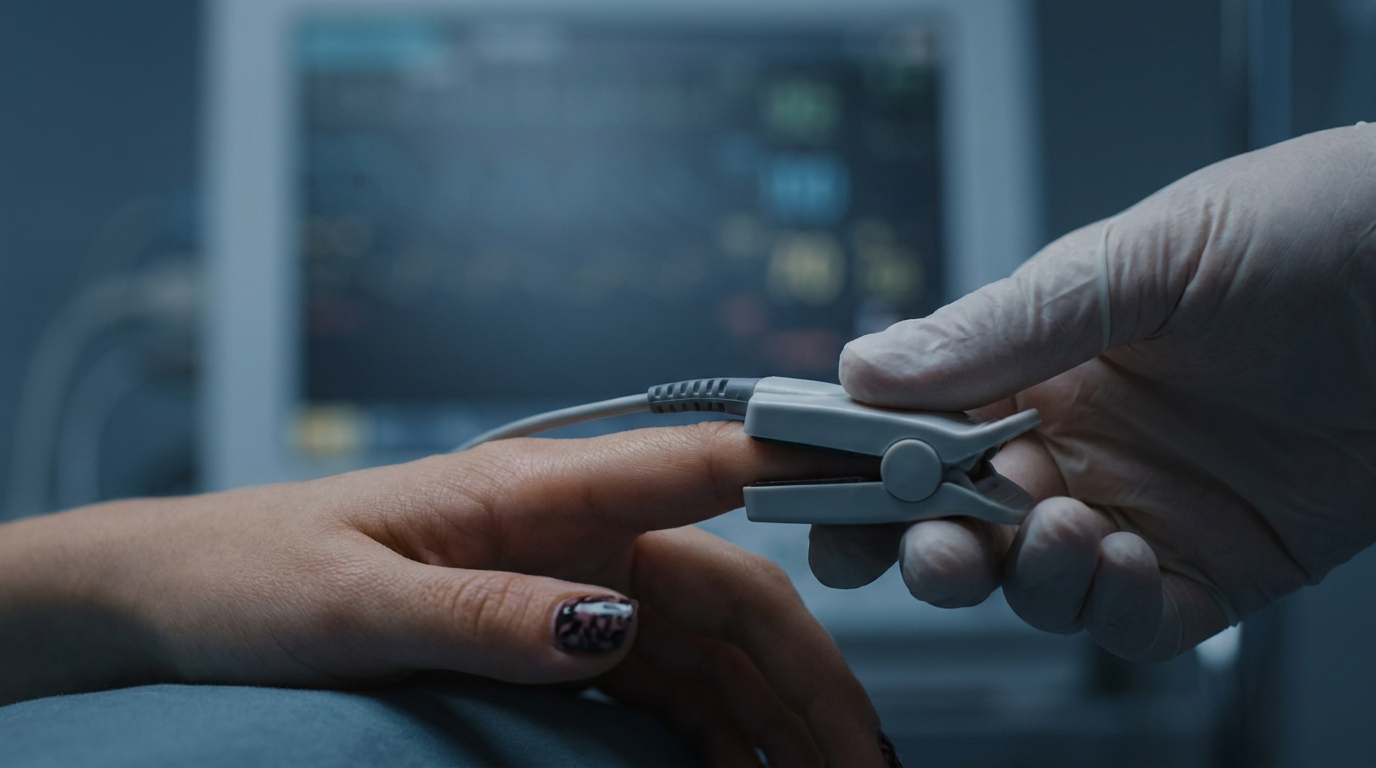
Pulse oximetry is one of the most commonly used monitoring methods in emergency medicine. Hardly any patient is handed over without an SpO₂ value, and hardly any initial assessment is done without the small clip on the finger. It is precisely this ubiquity that poses a risk: we often blindly trust the displayed value — and overlook the fact that pulse oximetry systematically delivers false or unreliable results in a number of clinically relevant situations. If you understand the physical principles and the specific sources of error, you can properly interpret the readings and avoid clinical misjudgments.
Physical Measurement Principle – Why Understanding Matters
Pulse oximetry is based on spectrophotometry. The sensor transmits light at two wavelengths through a perfused tissue bed — typically the finger:
- Red light (660 nm): Deoxyhemoglobin (HHb) absorbs more strongly here than oxyhemoglobin (O₂Hb).
- Infrared light (940 nm): Oxyhemoglobin absorbs more strongly here than deoxyhemoglobin.
The device calculates the ratio of absorption at both wavelengths (the so-called R/IR ratio) and derives the SpO₂ value from an empirically calibrated curve. The key point is: the pulse oximeter only measures functional saturation — that is, the ratio of O₂Hb to the sum of O₂Hb and HHb. By default, it detects only two hemoglobin species. Any additional hemoglobin variant, any interference with light absorption or pulse detection can distort the value.
Functional vs. Fractional Saturation
Fractional saturation (SaO₂), as determined by arterial blood gas analysis with co-oximetry, includes all hemoglobin species — including carboxyhemoglobin (COHb), methemoglobin (MetHb), and sulfhemoglobin. The formula is:
SaO₂ = O₂Hb / (O₂Hb + HHb + COHb + MetHb + …)
The conventional pulse oximeter simply does not recognize COHb and MetHb. It "sees" only two absorbers and interprets everything else as one of the two. This is precisely where the most dangerous sources of error lie.
Clinically Relevant Sources of Error in Detail
Carbon Monoxide Poisoning (COHb)
CO poisoning is the textbook example of a life-threatening measurement error. Carboxyhemoglobin has a nearly identical absorption spectrum to oxyhemoglobin at 660 nm. The pulse oximeter "confuses" COHb with O₂Hb and displays a falsely high SpO₂ value.
Clinical consequence:
- A patient with 40% COHb may display an SpO₂ of 99%, while the actual oxygen saturation is below 60%.
- Pulse oximetry is not reliable when CO poisoning is suspected.
- Diagnosis requires an arterial or venous blood gas analysis with co-oximetry or a specialized pulse oximeter with multi-wavelength technology (e.g., Masimo Rainbow SET®).
When to think of it?
- Fires in enclosed spaces
- Multiple persons with similar symptoms (headache, nausea, altered mental status)
- Heating season with poorly maintained gas heaters (a well-known seasonal phenomenon in Austria)
- Shisha/hookah use in poorly ventilated rooms
Methemoglobinemia (MetHb)
Methemoglobin is formed when the iron in hemoglobin is oxidized from Fe²⁺ to Fe³⁺. Fe³⁺ hemoglobin cannot transport oxygen. The absorption spectrum of MetHb is nearly equal at both wavelengths (660 nm and 940 nm) — the R/IR ratio approaches a value of 1.0, which corresponds to an SpO₂ of approximately 85% on the calibration curve.
The treacherous part: In mild methemoglobinemia, the pulse oximeter displays a falsely low value, while in severe methemoglobinemia it displays a falsely high value. Once MetHb levels reach approximately 30%, the SpO₂ "plateaus" at around 85% — regardless of how high the MetHb level actually rises.
Common triggers:
- Local anesthetics (prilocaine, benzocaine, lidocaine in high doses)
- Dapsone, nitrates, nitrites
- Industrial chemicals (aniline, nitrobenzene)
- Hereditary forms (rare)
Clinical tip: A patient who shows an SpO₂ of 85% despite oxygen administration and clinically presents with chocolate-brown cyanosis has methemoglobinemia until proven otherwise. Treatment consists of administering methylene blue (1–2 mg/kg IV).
Skin Pigmentation
Several studies have shown that pulse oximetry can systematically display falsely high SpO₂ values in patients with dark skin pigmentation. The deviation averages 2–4% but can be clinically significantly higher in individual cases. The inaccuracy increases particularly in the hypoxic range (SaO₂ < 90%).
Practical consequence: In patients with dark skin, you should consider "occult hypoxemia" (SpO₂ in the normal range with actually decreased SaO₂) in your differential thinking, especially when the clinical presentation does not match the reading. Blood gas analysis remains the gold standard.
Nail Polish, Artificial Nails, and Contamination
Dark nail polish — particularly blue, black, and green — can alter light absorption at 660 nm and thus falsely lower the SpO₂. Red and pink have less impact on the measurement according to current data. Acrylic nails and gel nails can also interfere.
Pragmatic solutions:
- Place the sensor on the earlobe or forehead
- Position the sensor laterally on the finger (90° rotation)
- Remove nail polish with acetone in an emergency
- Use a toenail (provided it is well perfused)
Peripheral Hypoperfusion and Centralization
The pulse oximeter requires a pulsatile vascular bed to separate the arterial signal component from venous and tissue components. During centralization — as occurs in shock, hypothermia, or with high-dose vasopressors — peripheral perfusion can be so severely reduced that the device cannot find a usable signal or delivers artifact-laden values.
Typical scenarios:
- Hemorrhagic shock
- Septic shock (late phase)
- Hypothermia (mountain rescue, avalanche victims, drowning incidents)
- Raynaud's phenomenon
- High-dose catecholamine therapy
Clinical tip: Pay attention to the quality of the pulse waveform (plethysmogram). A flat, irregular, or absent waveform signals that the displayed SpO₂ value is not reliable. Many devices also display a perfusion index (PI) — values below 0.5% suggest perfusion is too low for a reliable measurement.
Motion Artifacts
Any patient movement — shivering from cold, seizures, transport over rough terrain — generates artifacts. Modern devices with signal extraction algorithms are more resistant but not immune. This is an everyday problem, particularly in the prehospital setting.
Anemia
In severe anemia (Hb < 5 g/dL), pulse oximetry becomes increasingly unreliable because the total amount of hemoglobin is too low to generate a sufficient absorption signal. Furthermore, the available hemoglobin may be fully saturated (SpO₂ 100%) while the absolute oxygen content (CaO₂) is critically low. A "normal" SpO₂ does not rule out tissue hypoxia in severe anemia.
Dyshemoglobins and Rare Interfering Factors
In addition to COHb and MetHb, other substances and conditions can distort the measurement:
- Fetal hemoglobin (HbF): In neonates, HbF can lead to slight measurement deviations that are usually clinically tolerable.
- Intravascular dyes: Methylene blue (falsely low, ~65%), indocyanine green, patent blue V (sentinel lymph node diagnostics) — all cause temporarily drastic measurement errors.
- Strong ambient light: Operating room lights, direct sunlight, infrared lamps can interfere with the photoelectric measurement. Covering the sensor with an opaque cloth helps.
When SpO₂ Values Are Misleading – A Summary for Daily Practice
| Source of Error | Direction of Distortion | Countermeasure |
|---|---|---|
| COHb (CO poisoning) | Falsely high | Blood gas analysis with co-oximetry |
| MetHb (methemoglobinemia) | Converges toward 85% | Blood gas analysis, methylene blue |
| Dark skin pigmentation | Falsely high (2–4%) | Clinical correlation, blood gas analysis |
| Dark nail polish | Falsely low | Change sensor position, remove polish |
| Hypoperfusion/shock | Unreliable/no signal | Assess plethysmogram, ear clip |
| Severe anemia | Falsely normal (SpO₂ ≠ CaO₂) | Blood gas analysis, hemoglobin level |
| Motion artifacts | Variable | Stabilize signal, plethysmogram |
| Methylene blue IV | Falsely low (~65%) | Awareness of medication, blood gas analysis |
| Hypothermia | Unreliable | Core temperature, blood gas analysis |
Clinical Decision Rules
Rule 1: Clinical Assessment Trumps the Monitor
When your clinical assessment and the SpO₂ value do not match, the clinical picture is right until proven otherwise. A cyanotic, dyspneic patient with an SpO₂ of 98% needs the same attention as one with 88%.
Rule 2: The Plethysmography Waveform Is Your Friend
Before you interpret the numerical value, look at the waveform. A clean, regular pulse wave with adequate amplitude is a prerequisite for a reliable SpO₂. If it is absent, the displayed number is at best an estimate.
Rule 3: SpO₂ Is Not a Measure of Ventilation
Pulse oximetry measures oxygenation, not ventilation. A patient receiving supplemental oxygen can display an SpO₂ of 99% while simultaneously having a PaCO₂ of 90 mmHg. When hypoventilation is suspected (opioid intoxication, COPD exacerbation, neuromuscular disease), capnography or blood gas analysis is indispensable.
Rule 4: Consider the Oxygen-Hemoglobin Dissociation Curve
The relationship between PaO₂ and SpO₂ is not linear but sigmoid. Above an SpO₂ of 90%, small SpO₂ changes correspond to only minor PaO₂ fluctuations. Below 90%, however, small SpO₂ drops correspond to dramatic PaO₂ decreases. A drop from 94% to 90% is physiologically quite different from a drop from 90% to 86%.
Additionally, factors such as pH, temperature, PaCO₂, and 2,3-DPG shift the curve:
- Right shift (fever, acidosis, hypercapnia): O₂ is released to tissues more readily → SpO₂ may be lower at the same PaO₂.
- Left shift (hypothermia, alkalosis, COHb): O₂ is released to tissues less readily → SpO₂ may be higher at the same PaO₂, but tissue oxygenation is actually worse.
Rule 5: When in Doubt – Blood Gas Analysis
Arterial blood gas analysis with co-oximetry remains the gold standard for assessing oxygenation, ventilation, and dyshemoglobins. In the prehospital setting, where blood gas analysis is not available, the indication for blood sampling for the hospital should be established and communicated early.
Special Situations in Emergency Medicine
Cardiac Arrest
During cardiopulmonary resuscitation, pulse oximetry is of limited reliability. Chest compressions do generate an artificial pulse flow whose signal may be detected by the pulse oximeter; however, the reliability of the derived SpO₂ value is questionable. According to the AHA guidelines, pulse oximetry should not be used as the primary tool for guiding oxygenation during CPR. After ROSC, however, pulse oximetry is a valuable monitoring tool — bearing in mind the limitations mentioned above.
Fire Incidents
With every fire victim, you must assume possible CO poisoning and — if combustion products from synthetic materials have been inhaled — possible cyanide poisoning. Pulse oximetry is inadequate as the sole oxygenation monitoring in this scenario. High-flow oxygen (FiO₂ 1.0) is indicated regardless of the displayed SpO₂.
Neonatal Resuscitation
In the initial management of newborns, specific SpO₂ target values apply that increase over the first minutes of life. Measurement is performed preductally (right hand). It is important to note that signal quality in very small patients and immediately postpartum is frequently limited. Decisions regarding oxygen administration should never be based solely on an unstable SpO₂ value.
Take-Home Messages
- Pulse oximetry is a screening tool for hypoxemia — not a substitute for a differentiated oxygenation assessment.
- COHb and MetHb are not detected by conventional pulse oximeters and lead to potentially life-threatening misinterpretations.
- The quality of the plethysmography waveform is at least as important as the numerical value.
- When there is a discrepancy between clinical presentation and SpO₂: trust the clinical picture and obtain a blood gas analysis.
- SpO₂ measures oxygenation — not ventilation, not oxygen content, not tissue oxygenation.
Practical Training
The reliable interpretation of monitoring values — including pulse oximetry and its limitations — is a core component of emergency medicine competence. In the Emergency Physician Refresher Course by Simulation Tirol, you train in realistic simulation scenarios how to handle ambiguous or distorted readings, learn to systematically recognize pitfalls, and practice clinical decision-making under time pressure. Because in an emergency, it is not the device that saves lives — but your understanding of what it is actually telling you.
More Articles
Recognizing Agonal Breathing: How to Correctly Interpret Gasping
Agonal breathing is frequently misinterpreted as normal breathing, delaying the start of resuscitation. This article explains its characteristics, how to differentiate it from physiological breathing, and the consequences for first responders and healthcare professionals.
Acute Dyspnea: Differential Diagnosis and Immediate Management
Dyspnea has numerous causes ranging from asthma to heart failure to pulmonary embolism. This article presents a systematic approach to differentiation based on history, clinical examination, auscultation, and point-of-care diagnostics.
Acute Hypoglycemia: Emergency Management in Adults and Children
Threshold values, symptom recognition, oral glucose vs. IV dextrose vs. glucagon – with separate dosing for adult and pediatric patients. A common emergency presentation systematically reviewed.