Safe Sleeping in the Parents' Bed: Co-Sleeping Without Risk
Many parents take their baby into bed with them – but how can the risk of suffocation be minimized? This article explores evidence-based recommendations on co-sleeping, positioning, and room climate, and shows when immediate action is needed.

Author: Dr. med. univ. Daniel Pehböck, DESA
Specialist in Anesthesiology and Intensive Care Medicine, AHA-certified ACLS/PALS Instructor, Course Director Simulation Tirol
Reading time approx. 9 min
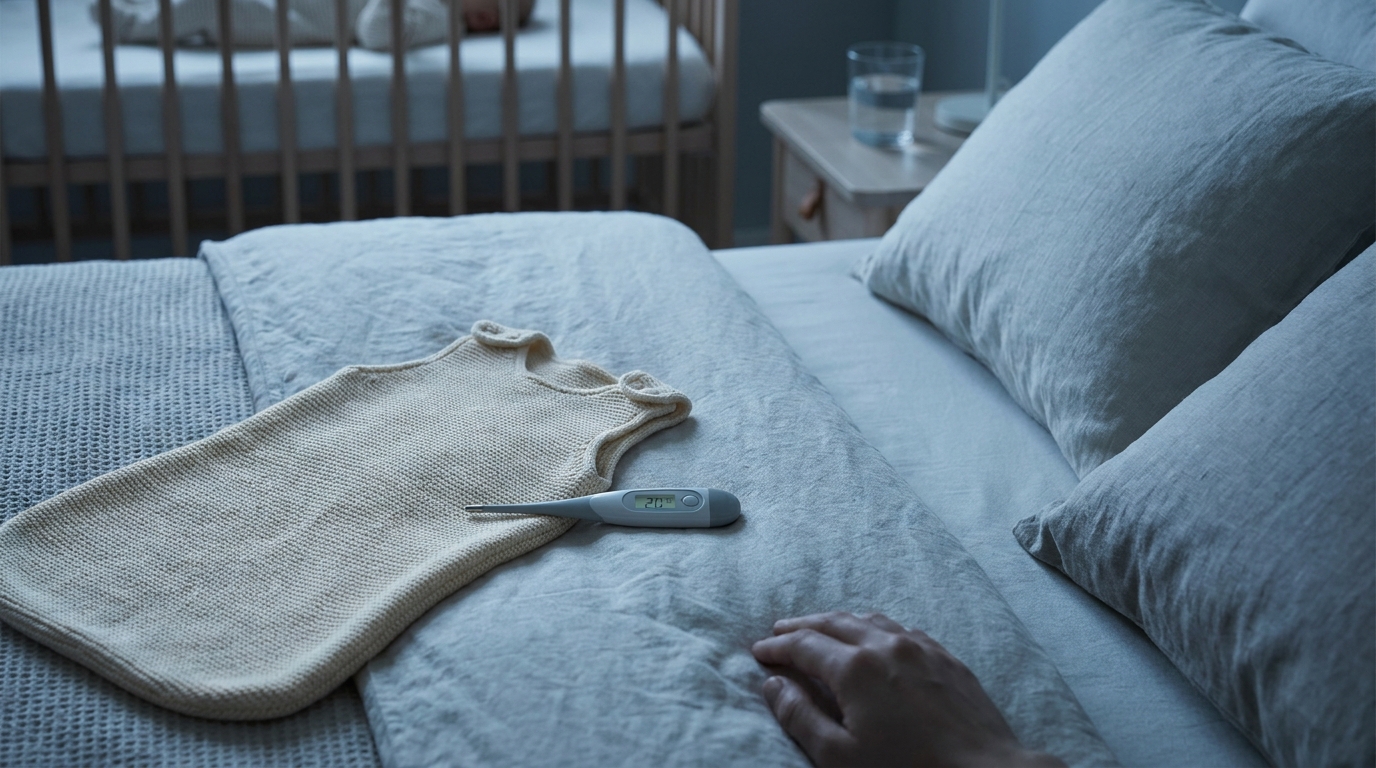
Many parents know the feeling: the baby simply sleeps better when lying close to mom or dad. The heartbeat, the warmth, the familiar scent – all of this soothes newborns in a way that no bedside crib, however lovely, can replace. Co-sleeping, meaning sharing the parents' bed, is practiced worldwide and has a tradition spanning thousands of years. At the same time, there are legitimate concerns: under certain circumstances, the risk of sudden infant death syndrome (SIDS) or suffocation accidents in the parents' bed increases significantly. The good news: with clear rules and the right knowledge, this risk can be substantially reduced. This article provides you as a parent, grandparent, or caregiver with concrete, evidence-based recommendations – so you can enjoy the closeness without putting your baby at risk.
What Exactly Does Co-Sleeping Mean?
Before we get into the details, it's important to distinguish two terms that are often confused:
- Co-sleeping means that parents and baby sleep in close proximity to each other. This can be in the same bed, but also with a bedside crib or a baby cot in the same room.
- Bed-sharing specifically refers to sharing the same sleeping surface – meaning the baby actually sleeps in your bed.
Most professional organizations, including the American Academy of Pediatrics (AAP), recommend room-sharing without bed-sharing as the safest option: the baby sleeps in its own crib but in the same room as the parents. Studies show that simply sleeping in the same room can reduce the SIDS risk by up to 50%.
However, the reality for many families is different. Breastfeeding mothers in particular take their baby into bed at night – often unplanned, because they fall asleep while nursing. That's exactly why it's so important not just to say "Don't do that," but to know concrete measures that minimize the risk.
Why Can the Parents' Bed Become Dangerous?
To understand the protective measures, it helps to know the actual sources of danger. The risks in the parents' bed are essentially:
Suffocation from soft surfaces
Adult beds are made for adults. Soft mattresses, thick duvets, large pillows, sheepskin overlays – all of these can obstruct a baby's airways. In the first months of life, babies don't yet have the strength to turn their head sufficiently when something covers their face.
Overheating
Babies regulate their body temperature much less effectively than adults. Under an adult duvet, snuggled between two adult bodies, the temperature can quickly rise to dangerous levels. Overheating is considered an independent risk factor for SIDS.
Entrapment and overlay
Between the mattress and the wall, between the mattress and the bed frame, or in gaps between two mattresses pushed together – a baby can become trapped. Accidental overlay by a parent is also a real – though rare – risk, especially when alcohol, medications, or extreme exhaustion are involved.
Falling
Adult beds are higher than baby cribs. A fall from the parents' bed can lead to serious injuries for infants, especially if the floor is hard.
The Seven Golden Rules for Safer Bed-Sharing
If you decide to take your baby into bed with you – or if you know it might happen during the night – then prepare the sleeping environment deliberately. The following rules are based on recommendations from international professional organizations and studies on infant sleeping environments:
1. Firm, flat mattress with no gaps
The mattress should be firm – similar to a baby mattress. No waterbeds, no sagging mattresses, no sofas or armchairs. If two mattresses are placed side by side, there must be no gap that the baby could slip into. Ideally, use one continuous, firm mattress.
2. No pillows, blankets, or stuffed animals near the baby
Remove all pillows, blankets, stuffed animals, and bumpers from the area where the baby lies. The baby should not sleep under the adult duvet. Instead, use a well-fitting baby sleeping bag appropriate for the room temperature.
3. Back position – always
Always place your baby on its back. The supine position is the safest sleeping position and has dramatically reduced SIDS rates worldwide since it was introduced as a standard recommendation. This also applies in the parents' bed: back, not side, not stomach.
4. No alcohol, no drugs, no sedating medications
This is perhaps the most important rule: if a parent has consumed alcohol, used drugs, or is taking medications that cause drowsiness (e.g., certain painkillers, sleeping pills, antihistamines), the baby must not be taken into bed. Under the influence of such substances, the natural arousal response is impaired – you won't notice during sleep if something is wrong.
5. No smoking
If a parent smokes – even if smoking doesn't occur in the bedroom – bed-sharing significantly increases the SIDS risk. The residues on skin, hair, and clothing (known as "third-hand smoke") are enough to increase the risk. For parents who smoke, room-sharing without bed-sharing is the safer choice.
6. Don't fall asleep on sofas or armchairs
Falling asleep with the baby on the sofa or in an armchair is one of the most dangerous sleeping situations of all. The risk of suffocation is many times higher than in a bed. If you notice you're getting drowsy while nursing on the sofa: it's better to move to the prepared bed with your baby than to doze off on the sofa.
7. Keep older siblings and pets away
Older siblings and pets should not sleep in the same bed as an infant. A toddler can roll onto the baby during sleep without noticing. Pets can cover the baby with their body weight or startle it.
Room Climate: The Underestimated Factor
The right room temperature is an essential protective factor that is often given too little attention:
- Ideal sleeping temperature for babies: 16–18 °C (61–64 °F). This sounds cool to many adults, but it's optimal for infants.
- Avoid overheating: No electric blankets, no hot water bottles in the bed. Hats are unnecessary indoors – babies release excess heat through their heads. A hat prevents exactly that.
- Fresh air: Regular ventilation before bedtime is sensible. A slightly tilted window can help but isn't essential – what matters is that the air isn't stuffy.
- Adjust clothing: As a rule of thumb, the baby wears one layer more than what you find comfortable. In a baby sleeping bag at 18 °C, a long-sleeved bodysuit and a light sleepsuit are often sufficient.
A simple test: feel the back of your baby's neck. If it's warm and dry, the temperature is right. If it's damp or hot, the baby is overdressed. Cold hands and feet are normal in babies, by the way, and are not a reliable indicator.
Special Risk Situations: When Bed-Sharing Should Be Off Limits
There are situations in which sleeping in the parents' bed is clearly too dangerous. In these cases, the baby should consistently sleep in its own crib (ideally a bedside crib right next to the parents' bed):
- Premature babies or babies with low birth weight: These children already have an increased SIDS risk and a limited ability to alert others when they have breathing problems.
- In the first four weeks of life: The SIDS risk is highest in the first weeks. A bedside crib is the safest solution for closeness without risk.
- Extreme exhaustion: If you're so tired that you could fall asleep standing up, your protective response during sleep is impaired. This is particularly common in the first few weeks. In this case, please place the baby in its own crib.
- Obesity of a parent: With significant excess weight, awareness of the baby's position in the bed is reduced, and the mattress can form a dip that the baby slides into.
Recognizing Warning Signs: When You Must Act Immediately
Even with the best preparation, emergencies can occur. The following signs are warning signs that require you to react immediately:
- The baby is not breathing or breathing irregularly (long pauses of more than 20 seconds)
- Bluish discoloration of lips, fingernails, or skin (cyanosis)
- The baby is limp and unresponsive to touch or voice
- The baby is unusually pale or gray and feels cold
What to do in such an emergency:
- Try to get a response: Gently touch the baby, talk to it, stimulate it (e.g., stroke the soles of the feet).
- Call emergency services: Dial 144 (in Austria) or 112 (European emergency number). Stay on the line and follow the dispatcher's instructions.
- Open the airway: Place the baby on its back on a firm surface. Bring the head into a neutral position (don't overextend!) – for infants, a slight extension is sufficient, the so-called "sniffing position."
- Begin rescue breaths and chest compressions: If the baby is not breathing and has no pulse, start resuscitation. For infants: 5 initial rescue breaths, then a ratio of 15 chest compressions to 2 rescue breaths. Chest compressions are performed with two fingers on the sternum, approximately one finger's width below the line connecting both nipples, compressing to a depth of about one-third of the chest diameter.
These steps sound simple in theory – but in a real emergency, with your own child, under adrenaline and panic, it's something completely different. That's exactly why hands-on training is so important.
Bedside Crib: The Golden Middle Ground
If you're unsure whether bed-sharing is right for you, or if one of the risk factors mentioned above applies, then a bedside crib is an excellent solution. The baby sleeps on its own firm mattress, in its own sleeping bag, without blankets and pillows – and is still only an arm's length away. You can take the baby to you for nursing and then place it back afterward. Most bedside cribs can be seamlessly adjusted to the height of the parents' bed and are securely attached so that no gap is created.
Breastfeeding and Co-Sleeping: A Natural Connection
It's no coincidence that bed-sharing and breastfeeding often go together. Breastfeeding mothers intuitively adopt a protective position at night – the so-called "C-position" or "cuddle curl": the mother lies on her side, her lower arm is extended above the baby's head (so she can't roll onto the baby), her knees are drawn up (so the baby can't slide downward). The baby lies at the mother's breast level.
Studies show that breastfeeding mothers who don't have any of the risk factors mentioned above have a very low SIDS risk with bed-sharing. This doesn't mean there's no risk – but it's significantly lower than in families where there is smoking, alcohol consumption, or sleeping on unsuitable surfaces.
Summary: Your Nighttime Checklist
Before you turn off the light, briefly go through these points:
- ✅ Firm, flat mattress with no gaps
- ✅ No pillows, blankets, or stuffed animals near the baby
- ✅ Baby in a sleeping bag, on its back
- ✅ Room temperature 16–18 °C (61–64 °F)
- ✅ No alcohol, no drugs, no sedating medications
- ✅ No smoking in the household
- ✅ No older children or pets in the bed
- ✅ Don't fall asleep on the sofa or in an armchair
- ✅ For premature babies, very young infants, or extreme exhaustion: use a bedside crib
Hands-On Training
All this knowledge about safe sleeping environments is important – but in an emergency, what counts is whether you can perform the right techniques. What do you do if your baby suddenly stops breathing? How do you perform chest compressions on an infant? How do you give rescue breaths correctly? These things can't be learned from an article – they need to be practiced, with your hands, on a manikin, under guidance. In the baby resuscitation course from Simulation Tirol, you learn exactly these life-saving skills in a relaxed atmosphere. Step by step, no prior knowledge required, with plenty of time to practice. So that in an emergency, you don't hesitate – you act.
Want to practice this hands-on?
In our Baby-Reanimationskurs you practice this topic hands-on with high-tech simulators and experienced instructors.
More Articles
Respiratory Distress Syndrome in Newborns: Causes and Initial Management
Transient tachypnea, meconium aspiration, and surfactant deficiency – how healthcare professionals and parents can distinguish the most common causes of neonatal respiratory distress and which immediate measures can be lifesaving.
Airway Obstruction in Infants: Back Blows and Chest Thrusts
Detailed lay-rescuer guide for choking emergencies in babies under 1 year: positioning, blow technique, alternating measures, and when to call emergency services.
Baby Not Breathing: Infant CPR for Laypeople
A clear, easy-to-understand guide to cardiopulmonary resuscitation (CPR) for babies under one year of age. This article explains how to check breathing, perform rescue breaths, and give chest compressions with the correct hand position – specifically designed for parents and grandparents with no medical background.