Cardiac Arrest in the Water: Resuscitation at the Pool's Edge
What do you do when someone suffers a cardiac arrest in a swimming pool or lake? This article covers proper rescue techniques, the specifics of ventilation in wet patients, and the modified resuscitation algorithm – practical guidance for first responders and rescue personnel.

Author: Dr. med. univ. Daniel Pehböck, DESA
Specialist in Anesthesiology and Intensive Care Medicine, AHA-certified ACLS/PALS Instructor, Course Director Simulation Tirol
Reading time approx. 9 min
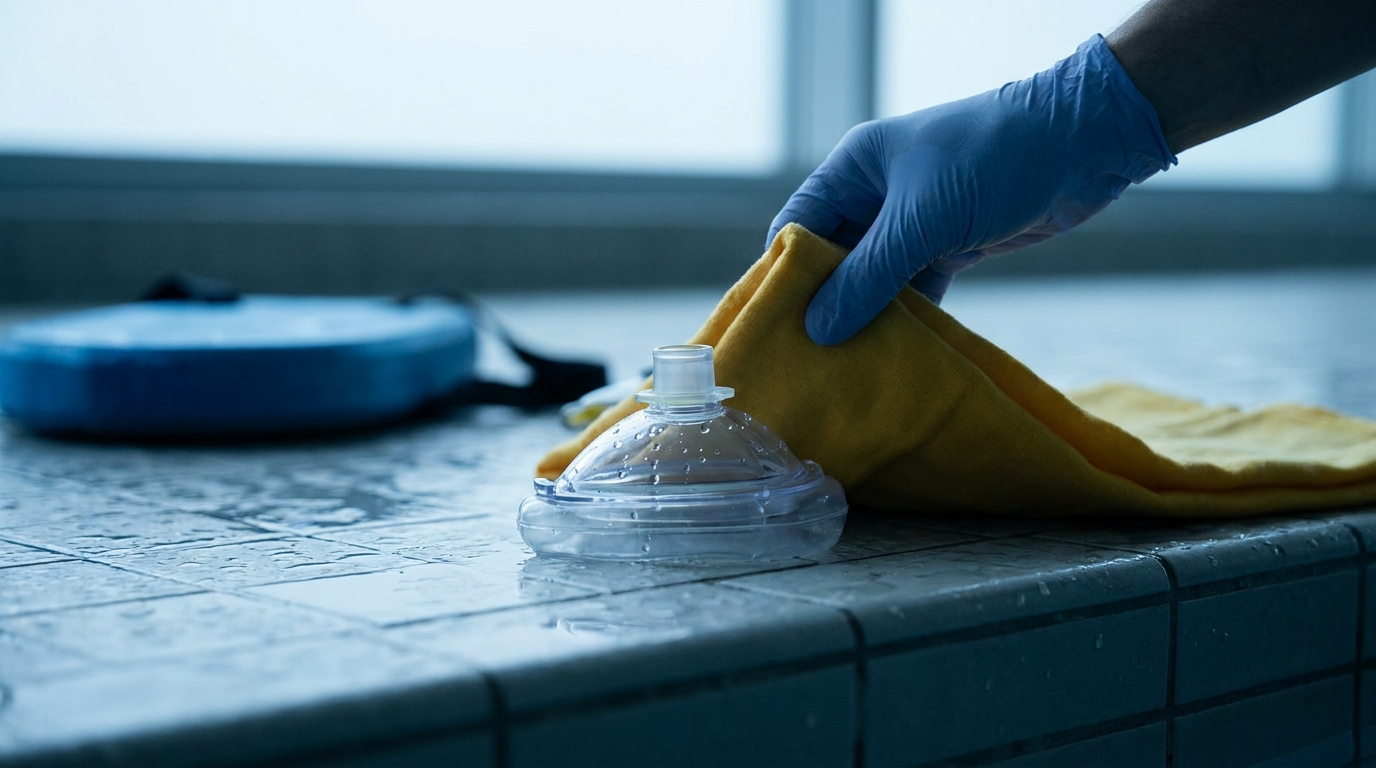
A cardiac arrest in the water is one of the most time-critical emergency situations there is. The combination of submersion, hypoxia, and frequently accompanying hypothermia presents unique challenges for both first responders and professional rescue personnel. Unlike a "classic" cardiac arrest on land, resuscitation in an aquatic environment requires a modified approach – from safe rescue from the water, to prioritizing ventilation, to defibrillation at the wet poolside. In this article, you'll learn what special considerations apply, what mistakes you should avoid, and how you can decisively improve survival chances for those affected.
Epidemiology and Pathophysiology: Why Drowning Emergencies Are Different
Drowning is one of the most common causes of preventable death worldwide. Incidents regularly occur in swimming pools, lakes, and private pools – affecting children as well as older adults. The causes of cardiac arrest in the water are varied:
- Primary drowning: Aspiration of water leads to hypoxia, which progresses to cardiac arrest.
- Secondary cardiac arrest: A cardiac cause (e.g., arrhythmia, long QT syndrome, hypertrophic cardiomyopathy) leads to loss of consciousness in the water, with drowning as the consequence.
- Trauma: Diving into shallow water resulting in cervical spine injury or traumatic brain injury.
- Hypothermia: Cold shock, swim failure, and progressive cooling, especially in open water.
The critical pathophysiological difference from cardiac arrest on land: The primary cause in most cases is hypoxia. The heart does not stop primarily due to a rhythm disturbance, but because oxygen deprivation leads to progressive bradycardia and ultimately asystole. This leads to a fundamental consequence for the resuscitation algorithm: Ventilation has a higher priority in drowning emergencies than in other causes of cardiac arrest.
Personal Safety and Safe Rescue: Before You Enter the Water
Before you approach the victim, one ironclad principle applies: Personal safety comes first. Drowning is contagious – in a figurative sense. Drowning persons reflexively cling to rescuers, pull them underwater, and put them in acute danger. Every year, first responders are injured or killed because they enter the water without adequate safeguards.
Rescue Priority Sequence
- Talk: Is the person conscious and near the shore? Give verbal instructions – "Swim over here!", "Hold on to the edge!"
- Reach: Extend a pole, towel, piece of clothing, or rescue ring – without entering the water yourself.
- Throw: Throw a rescue ring, rescue ball, PET bottle, or other buoyant object.
- Wade: In shallow water, carefully wade in, keeping a rescue device between yourself and the victim whenever possible.
- Swim (trained rescuers only!): Only as a last resort, ideally with rescue equipment (rescue buoy, rescue sling). Approach from behind.
Special Consideration: Unconscious Person in the Water
If the person is unresponsive, you must assume a cardiac arrest. In shallow water (swimming pool, non-swimmer pool): Immediately approach the victim, bring their head above water, and open the airway. In deep water: Call emergency services (144) and wait for professional water rescue if you are not a trained lifeguard.
Important: Trained water rescuers can begin ventilation while still in the water (in-water resuscitation). However, chest compressions in the water are ineffective and are not recommended. The priority is to get the person onto land or a firm surface as quickly as possible.
Extrication from the Water: What You Need to Watch For
Extrication is physically demanding and carries additional risks. A soaked, unconscious person is heavy and unwieldy. The following principles apply during extrication:
- Prefer horizontal extrication: If possible, lift the person flat out of the water – do not pull them out vertically. In hypothermic patients, abrupt uprighting can lead to so-called rescue collapse (afterdrop phenomenon due to return of cold blood to the heart).
- Cervical spine immobilization: Only when there is specific suspicion of trauma (diving into shallow water, visible injuries). Routine cervical spine immobilization in all drowning incidents delays resuscitation and is not recommended per guideline recommendations.
- Onto a firm, flat surface: Lay the person on their back at the pool's edge, dock, or shore. The surface should be firm enough to allow effective chest compressions.
- Wet clothing: At minimum, expose the upper body – for defibrillation and chest compressions.
The Modified Resuscitation Algorithm for Drowning
The guidelines of the European Resuscitation Council (ERC) and the American Heart Association (AHA) provide clear recommendations for resuscitation after drowning. The algorithm differs from the standard BLS algorithm in one essential point:
Step-by-Step Approach
- Ensure safety – Personal safety, call 144
- Check responsiveness – Call out, shake the shoulders
- Open the airway – Head tilt, chin lift. Remove vomitus or foreign bodies from the mouth.
- Check breathing – Look, listen, feel – maximum 10 seconds
- 5 initial rescue breaths – This is the key difference! In a drowning emergency, you start with 5 rescue breaths, not with chest compressions. Reason: Hypoxia is the primary cause.
- Check for signs of life – Does the person respond to the rescue breaths? Are they coughing, moving?
- 30 chest compressions – If no signs of life are present
- Then continue 30:2 – 30 compressions, 2 rescue breaths, alternating
Why 5 Initial Rescue Breaths?
The lungs are the target organ in drowning. Aspirated water, surfactant washout, and atelectasis prevent gas exchange. The initial 5 rescue breaths serve to increase alveolar oxygen content as quickly as possible. Often, the first rescue breaths alone are enough to initiate resuscitation when residual circulatory function is still present.
Key point: Many drowning victims survive through early ventilation alone, even before chest compressions are started. This effect is especially pronounced in children, as pediatric cardiac arrest is almost always hypoxia-related.
Ventilation in Wet Patients: Practical Challenges
Ventilation at the poolside presents specific difficulties:
Wet Face and Seal
- Mouth-to-mouth ventilation: The wet face makes achieving a seal more difficult. If possible, briefly dry the mouth and nose area with a towel. Pinch the victim's nose firmly closed and ensure good head tilt.
- Bag-valve-mask ventilation: If available (e.g., in swimming pools with first aid equipment), bag-valve-mask ventilation is preferred. Here too: dry the face as much as possible and press the mask firmly (C-E grip).
- Pocket mask/face shield: Many first responders carry a pocket mask on their keychain. These work well even on a wet face.
Gastric Distension and Vomiting
Drowning victims have often swallowed water. The stomach is distended. During ventilation, there is a high risk of:
- Regurgitation and aspiration: Ventilate slowly and with normal volume (no forceful insufflation!). Each breath should take about 1 second and produce a visible chest rise.
- Vomiting: If the victim vomits, immediately turn them into the recovery position, clear the mouth, then resume resuscitation. Be prepared for this – vomiting is the rule in drowning, not the exception.
- No Heimlich maneuver: Do not attempt to remove water from the lungs. Head-down positioning or pressing on the abdomen is counterproductive and wastes valuable time.
Defibrillation at the Poolside: Is It Safe?
The question of whether you can use an AED (automated external defibrillator) near water causes uncertainty for many first responders. The answer is clear:
Yes, defibrillation is safe as long as you follow basic rules:
- Get the patient out of the water. Never use an AED while the victim is still in the water.
- Dry the chest. The electrode pads must adhere to dry skin; otherwise, they conduct the current across the skin surface instead of through the thorax. Shave chest hair if needed (a razor is included in AED carrying cases).
- Puddles on the ground: As long as the person is not lying in a continuous body of water and the rescuers are not standing directly in water, defibrillation is safe. Small puddles at the poolside do not pose a relevant risk.
- Remove wet clothing: At minimum, expose the upper body so that the pads can be correctly placed.
Special Consideration: Shockable vs. Non-Shockable Rhythm
In primary drowning emergencies, the initial rhythm is most often asystole or pulseless electrical activity (PEA) – a non-shockable rhythm. The AED will not recommend a shock in these cases but will still provide valuable information. Always attach the AED anyway – because:
- Ventricular fibrillation can occur as a secondary rhythm.
- In cardiac-related cardiac arrest in water (e.g., with known pre-existing heart disease), a shockable rhythm is entirely possible.
- The rhythm analysis helps the emergency medical services with further management.
Hypothermia: The Special Case in Open Water
In lakes, rivers, or the sea, water temperature can be significantly below core body temperature. Hypothermia fundamentally changes resuscitation:
- "Nobody is dead until warm and dead" – This principle applies especially in drowning. Hypothermic patients have a significantly better prognosis than normothermic patients, as hypothermia protects the brain from hypoxic damage.
- Do not stop resuscitation: Even with a prolonged submersion interval and absent signs of life, you should begin resuscitation and continue until emergency medical services arrive. The decision to terminate resuscitation is made exclusively by an emergency physician.
- Careful extrication and positioning: Hypothermic hearts are extremely susceptible to ventricular fibrillation. Avoid abrupt movements and position changes.
- Passive thermal insulation: Remove wet clothing if possible, use a rescue blanket or dry blankets. No active rewarming by first responders (no hot water, no hot water bottles on the skin).
Special Considerations for Children
Children are particularly at risk in the water. Toddlers can drown in just a few centimeters of water – silently and without splashing. Resuscitation in children essentially follows the same modified algorithm:
- 5 initial rescue breaths (in infants: mouth-to-mouth-and-nose)
- Chest compressions with adapted technique: In infants, two thumbs or two fingers on the lower third of the sternum; in children, one or two hands depending on body size
- Compression depth: At least one-third of the anteroposterior chest diameter
- 15:2 with two rescuers, 30:2 with a single rescuer
The prognosis in children – especially in cold water – is often remarkably good, even after prolonged submersion. There are documented cases of neurologically intact survival after more than 30 minutes underwater in cold water.
Common Mistakes and Myths
- "First press the water out of the lungs" – Wrong. The aspirated volume of water is usually small and does not impede ventilation. Any attempt to remove water wastes time.
- "Compressions first" – Correct for standard cardiac arrest, but suboptimal in drowning. Ventilation takes priority.
- "The AED must not be used at the poolside" – Wrong, as long as the victim is out of the water and the chest is dry.
- "After 10 minutes underwater, it's too late" – Wrong, especially in cold water. Never withhold resuscitation based on an estimated submersion time.
- "Recovery position only for unconscious patients who are breathing" – Correct. If the victim is breathing spontaneously after rescue, place them in the recovery position and monitor closely. Every person after a submersion event must receive medical evaluation, even if they initially appear symptom-free (risk of secondary pulmonary edema).
Summary: Key Points at a Glance
| Step | Action |
|---|---|
| Personal safety | Do not enter the water unsecured – Talk, Reach, Throw, Wade, Swim |
| Emergency call | 144 (emergency medical services), alert water rescue if applicable |
| Extrication | Horizontal, rapid, cervical spine immobilization only if trauma is suspected |
| Airway | Clear, head tilt |
| Ventilation | 5 initial rescue breaths, then 30:2 |
| Compressions | Hard, fast, full recoil (100–120/min, 5–6 cm deep) |
| AED | Dry the chest, apply electrode pads, follow the device |
| Hypothermia | Continue resuscitation – "warm and dead" principle |
Practical Training
The theory behind resuscitation at the poolside can be conveyed in articles – but correct action in a real emergency requires hands-on practice. Coordinating rescue, ventilation, and chest compressions under stress, safely applying an AED on wet skin, and making the right decision in a split second are skills that can only be internalized through repeated training. In our first responder training course, you train exactly these scenarios realistically on simulation manikins – guided by experienced instructors who provide you with structured feedback. Because in an emergency, what matters is not what you've read, but what you've practiced.
Want to practice this hands-on?
In our Ersthelfer-Ausbildung (16 Stunden) you practice this topic hands-on with high-tech simulators and experienced instructors.
More Articles
Automated External Defibrillator: A Guide for First Responders
AEDs are widely available, but many laypeople hesitate to use them. This article explains how they work, correct pad placement, common mistakes, and provides practical tips for training first responders in the workplace.
Electrical Near-Drowning in the Bathtub: Emergency Management
A combination emergency involving electrical injury and submersion in young children in the home environment. This article covers rescue with self-protection, the specifics of resuscitation with concurrent electrical contact and aspiration, and post-event monitoring.
First Aid for Seizures: Positioning, Protection, and Calling Emergency Services
Laypeople and first responders often look for concrete instructions on how to handle epileptic seizures. This article debunks common myths and provides a clear step-by-step guide.