Carbon Monoxide Poisoning: Symptoms and Emergency Treatment
CO poisoning is frequently overlooked due to its nonspecific symptoms. This article covers diagnostics with CO-oximetry, oxygen therapy, indications for hyperbaric therapy, and common pitfalls with pulse oximetry.

Author: Dr. med. univ. Daniel Pehböck, DESA
Specialist in Anesthesiology and Intensive Care Medicine, AHA-certified ACLS/PALS Instructor, Course Director Simulation Tirol
Reading time approx. 8 min
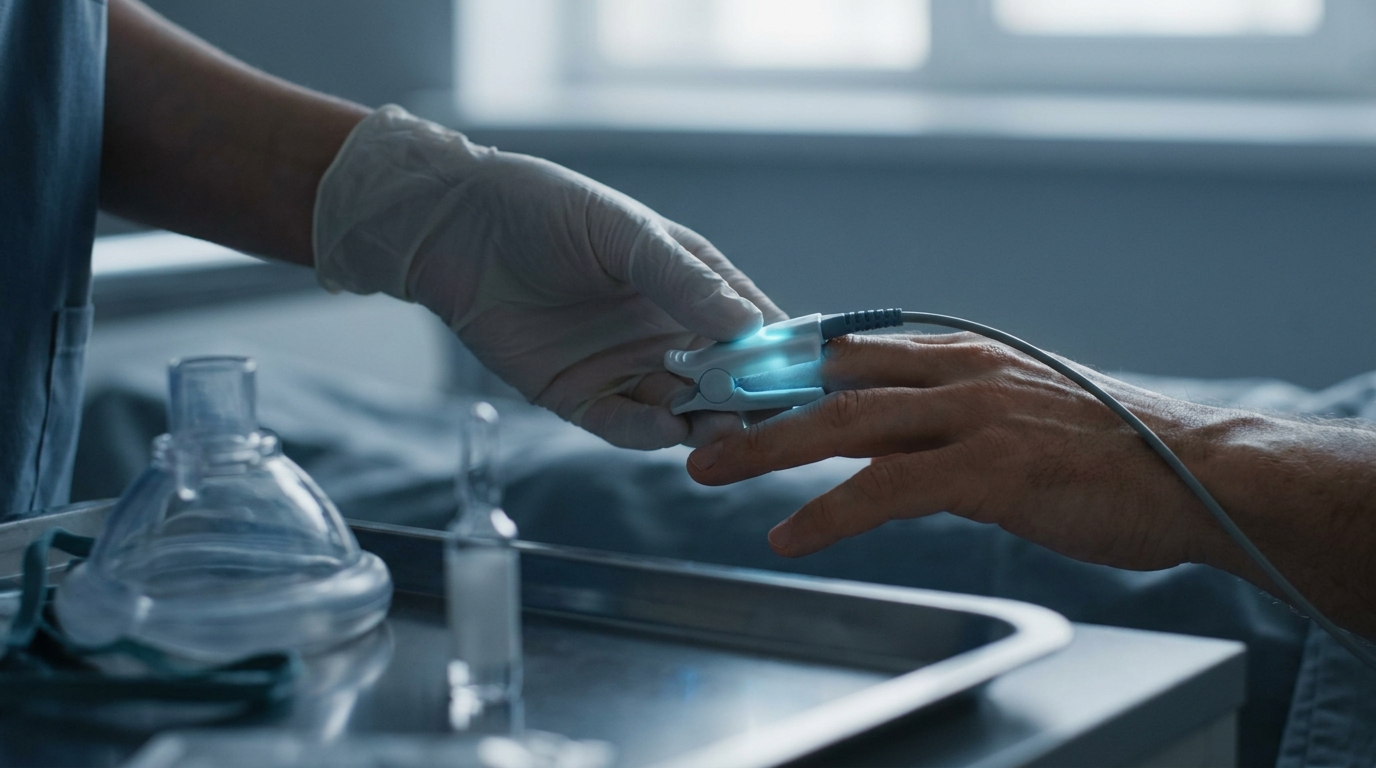
Carbon monoxide poisoning (CO poisoning) is one of the most common lethal poisonings worldwide – and at the same time one of the most frequently missed emergencies in clinical practice. The reason lies in the nature of the gas itself: carbon monoxide is colorless, odorless, and tasteless. The clinical symptoms are so nonspecific that they can easily be misinterpreted as a flu-like illness, migraine, or gastroenteritis. For emergency physicians, EMS teams, and emergency department staff, the systematic recognition and correct initial treatment of CO poisoning is therefore a core competency that determines neurological outcome and survival in critical situations.
Pathophysiology: Why Carbon Monoxide Is So Dangerous
To understand the diagnostics and treatment, it is worth taking a brief look at the pathophysiological mechanisms. CO exerts its toxicity through multiple pathways:
- Hemoglobin binding: CO binds to hemoglobin with approximately 200 to 250 times greater affinity than oxygen. The resulting carboxyhemoglobin (COHb) is functionally inactive and does not transport oxygen. Additionally, CO shifts the oxygen dissociation curve to the left, further impairing oxygen delivery to tissues.
- Myoglobin binding: CO also binds to myoglobin in skeletal and cardiac muscle, which can contribute to cardiac dysfunction and rhabdomyolysis.
- Cytochrome c oxidase inhibition: At the mitochondrial level, CO inhibits cytochrome c oxidase and thereby impairs the cellular respiratory chain. This mechanism explains why severe tissue damage can occur even at moderate COHb levels.
- Inflammatory cascade: CO triggers an inflammatory cascade through oxidative stress and lipid peroxidation, which can lead to delayed neurological damage particularly in the CNS – the feared Delayed Neurological Sequelae (DNS).
The combination of these mechanisms makes it clear: the COHb level alone correlates poorly with clinical severity. A patient with a COHb of 15% may show severe symptoms, while another with 25% may initially appear minimally affected.
Clinical Presentation: The Chameleon of Emergency Medicine
The clinical symptoms of CO poisoning are notoriously nonspecific and stage-dependent. This makes the poisoning a diagnostic chameleon.
Mild Poisoning (COHb approx. 10–20%)
- Headache (frontal predominance, often the leading symptom)
- Nausea, vomiting
- Dizziness
- General weakness, fatigue
- Difficulty concentrating
Moderate Poisoning (COHb approx. 20–40%)
- Severe headache
- Confusion, agitation
- Visual disturbances
- Tachycardia, tachypnea
- Ataxia, coordination impairment
- Chest pain (particularly in patients with pre-existing coronary artery disease)
Severe Poisoning (COHb > 40%)
- Altered level of consciousness to coma
- Seizures
- Cardiac arrhythmias, myocardial ischemia
- Pulmonary edema
- Lactic acidosis
- Circulatory failure, cardiac arrest
Common Pitfalls in Symptom Attribution
- "Flu outbreak": Multiple family members present simultaneously with headache, nausea, and malaise → always consider CO, especially during the heating season.
- Children and elderly patients: Children often show symptoms earlier (higher respiratory rate, higher metabolic rate). In elderly patients, symptoms are frequently misinterpreted as cerebrovascular insufficiency or dementia.
- Cherry-red skin discoloration: This classic textbook sign is in practice a late finding and is observed almost exclusively postmortem or in the most severe poisonings. Never rely on it.
Diagnostics: CO-Oximetry as the Gold Standard
The Pulse Oximetry Pitfall
This is one of the most clinically relevant pitfalls: Conventional pulse oximetry (SpO₂) cannot detect CO poisoning. Standard pulse oximeters operate with two wavelengths (660 nm and 940 nm) and cannot reliably distinguish oxyhemoglobin (O₂Hb) from carboxyhemoglobin (COHb). COHb absorbs light at 660 nm almost identically to O₂Hb.
The result: A patient with a COHb of 40% and an actual O₂Hb of 55% may display an SpO₂ of 95–99% on the pulse oximeter. The falsely high SpO₂ lulls the team into a false sense of security.
Key point: A normal SpO₂ does not rule out CO poisoning. COHb measurement must be performed whenever CO exposure is suspected.
CO-Oximetry: Blood Gas Analysis with COHb Measurement
Arterial or venous blood gas analysis with integrated CO-oximetry is the diagnostic gold standard. Modern blood gas analyzers measure with multiple wavelengths and can differentiate the various hemoglobin fractions:
- O₂Hb (Oxyhemoglobin)
- COHb (Carboxyhemoglobin)
- MetHb (Methemoglobin)
- HHb (Deoxyhemoglobin)
Normal COHb values:
- Non-smokers: < 3%
- Smokers: up to 10% (up to 15% with heavy consumption)
Important: A venous blood gas is sufficient for COHb determination and differs only marginally from arterial values. In an acute situation, diagnostics should not be delayed by searching for an arterial puncture site.
Prehospital CO Measurement
Some newer pulse oximeter models (multi-wavelength pulse oximetry, e.g., Masimo Rad-57 with SpCO) enable non-invasive, transcutaneous COHb estimation. These devices can be helpful for screening, but their accuracy is limited and does not replace laboratory confirmation. Trends and screening values are usable, but therapeutic decisions should be based on CO-oximetry from blood gas analysis.
Additional Diagnostics
- 12-lead ECG: Mandatory in every CO poisoning case. ST-segment changes and arrhythmias are common, even in younger patients without pre-existing cardiac disease.
- Troponin: Myocardial injury has been described even in moderate CO poisoning. Troponin monitoring is recommended.
- Lactate: Elevated lactate indicates tissue hypoxia and correlates better with clinical severity than the COHb level alone.
- Neurological status: Documentation using GCS and targeted cognitive assessment (orientation, arithmetic ability, short-term memory). Cognitive deficits in CO poisoning are frequently underestimated.
Emergency Treatment: Oxygen as the Antidote
Immediate Measures
Scene safety and hazard zone: Rescue personnel must protect themselves. CO detection devices on the rescue vehicle are essential. Remove patients from the contaminated environment as quickly as possible.
High-dose oxygen therapy – 100% O₂: The half-life of COHb is:
- On room air (21% O₂): approx. 240–320 minutes
- On 100% O₂ via reservoir mask: approx. 60–90 minutes
- With hyperbaric oxygenation (HBO, 2.5–3 ATA): approx. 20–30 minutes
Immediately administer 100% oxygen via a tight-fitting reservoir mask (non-rebreather mask) at a flow rate of 15 L/min. Intubated patients are ventilated with 100% FiO₂.
Monitoring: Continuous ECG monitoring, repeated blood gas analysis with COHb, lactate, troponin.
Symptomatic treatment: Treat seizures with benzodiazepines (midazolam 0.1 mg/kg IV). In cardiac arrest, standard ALS algorithms apply.
Duration of Oxygen Therapy
100% O₂ should be continued until clinical improvement and a COHb decrease to below 5% (non-smokers) or below 10% (smokers). In practice, this usually means at least 6 hours. Even after normalization of the COHb level, mitochondrial toxicity may persist – clinical improvement is therefore just as decisive as the laboratory value.
Hyperbaric Oxygen Therapy (HBO): When to Refer?
Hyperbaric oxygenation is the most effective method for COHb elimination and additionally addresses mitochondrial toxicity as well as inflammatory processes. However, the indication remains a point of discussion, as the evidence regarding DNS prevention is heterogeneous.
Accepted Indications for HBO Therapy
Most international recommendations and toxicological guidelines cite the following indications:
- Altered level of consciousness (GCS < 15) at any point during the poisoning
- COHb > 25% (in pregnant patients > 15–20%)
- Cardiac ischemia or arrhythmias associated with CO poisoning
- Pregnant patients (fetal hemoglobin has an even higher CO affinity; the fetal COHb level is typically 10–15% above the maternal level)
- Persistent neurological symptoms despite normobaric hyperoxic therapy
- Seizures
Practical Considerations
- HBO therapy should ideally begin within 6 hours after the end of exposure, although initiation up to 24 hours after exposure is still considered beneficial.
- In Austria, HBO chambers are available at only a few centers. The decision to transfer must be made early. Contacting the nearest HBO center and the poison information center (in Austria: VIZ, Vergiftungsinformationszentrale) is recommended in moderate to severe CO poisoning.
- Transport time vs. treatment initiation: The start of high-dose normobaric hyperoxic therapy must not be delayed by planning an HBO transport. 100% O₂ is started immediately and continued throughout the entire transport.
Delayed Neurological Sequelae (DNS): The Underestimated Late Risk
Up to 40% of patients with moderate to severe CO poisoning develop delayed neuropsychiatric symptoms within 2 to 40 days after exposure:
- Cognitive deficits (memory, concentration, executive functions)
- Personality changes
- Parkinson-like movement disorders
- Depression, anxiety disorders
- Dementia-like symptoms
The risk of DNS is not linearly linked to the initial COHb level. Even patients with initially moderate poisoning can develop DNS. HBO therapy appears to reduce the DNS risk, although the evidence is not conclusive. In any case, consistent follow-up with neurological and neuropsychological evaluation is essential.
Special Patient Populations
Pregnant Patients
Pregnant patients deserve special attention: fetal hemoglobin binds CO even more strongly than adult hemoglobin. The fetal COHb level cannot be measured directly and is significantly higher than the maternal level. COHb elimination in the fetus is also considerably slower. The indication for HBO therapy is therefore applied more liberally (COHb > 15–20% or any symptoms). Oxygen therapy in pregnant patients should be continued for at least five times the duration required to normalize the maternal COHb.
Children
Children often show symptoms earlier due to their higher respiratory rate and higher metabolic demand. However, diagnosis is more difficult since young children cannot articulate headache and dizziness. In cases of unexplained lethargy, vomiting, or altered consciousness in a child – especially when other household members are also affected – CO poisoning must be considered as a differential diagnosis.
Patients with Cardiovascular Comorbidities
In patients with pre-existing coronary artery disease or heart failure, even low COHb levels (< 10%) can trigger myocardial ischemia. The threshold for aggressive therapy and inpatient monitoring should be significantly lower in these patients.
Tactical Considerations for EMS
- CO detection device: Every emergency vehicle should be equipped with a CO detector. When entering unclear scenes (unconsciousness in enclosed spaces, multiple affected persons, heating systems), the CO detector is mandatory.
- Contextual information: Actively ask about gas water heaters, wood-burning stoves, charcoal grills in enclosed spaces, running engines in garages, and hookah pipes. During the heating season, the incidence is significantly higher.
- Alert the fire department: If CO is suspected at the scene, the fire department must be dispatched for measurement and ventilation. Other residents or neighbors in multi-unit buildings may also be affected.
- Documentation: COHb level, time of exposure (as far as estimable), duration of exposure, and clinical findings must be carefully documented – also for the subsequent decision regarding HBO therapy.
Summary: Key Points for Clinical Practice
- CO poisoning is a mimicry emergency – with unclear, nonspecific symptoms (headache, nausea, dizziness) and a fitting history, always consider it.
- Conventional pulse oximetry is unreliable and shows falsely normal values. CO-oximetry via blood gas analysis is the gold standard.
- 100% oxygen via non-rebreather mask – start immediately – oxygen is the antidote.
- The severity of poisoning correlates poorly with the COHb level alone. Clinical presentation, lactate, and troponin complement the assessment.
- Consider HBO therapy for altered consciousness, COHb > 25%, cardiac involvement, pregnancy, or persistent neurological symptoms.
- Think about Delayed Neurological Sequelae and arrange neurological follow-up.
- Scene safety always comes first – CO detection devices on rescue vehicles are not optional, they are a necessity.
Hands-On Training
CO poisoning is an emergency where sound knowledge of pathophysiology, diagnostic pitfalls, and treatment algorithms makes the critical difference. In our emergency physician refresher courses at Simulation Tirol, you train using realistic scenarios to develop a structured approach to poisoning emergencies – from initial assessment to correct diagnostics to treatment decisions including HBO indications. The combination of case simulation and practice-oriented debriefing anchors exactly those action patterns you need in the field. You can find all information about the course on our website at Emergency Physician Refresher.
More Articles
Recognizing Agonal Breathing: How to Correctly Interpret Gasping
Agonal breathing is frequently misinterpreted as normal breathing, delaying the start of resuscitation. This article explains its characteristics, how to differentiate it from physiological breathing, and the consequences for first responders and healthcare professionals.
Acute Dyspnea: Differential Diagnosis and Immediate Management
Dyspnea has numerous causes ranging from asthma to heart failure to pulmonary embolism. This article presents a systematic approach to differentiation based on history, clinical examination, auscultation, and point-of-care diagnostics.
Acute Hypoglycemia: Emergency Management in Adults and Children
Threshold values, symptom recognition, oral glucose vs. IV dextrose vs. glucagon – with separate dosing for adult and pediatric patients. A common emergency presentation systematically reviewed.