Atropine Poisoning in Children: Recognizing Deadly Nightshade and Related Plants
Children frequently ingest plant parts such as deadly nightshade or angel's trumpet. This article describes the anticholinergic toxidrome in children, key symptoms, risk assessment, and emergency treatment with physostigmine – including weight-based dosing.

Author: Dr. med. univ. Daniel Pehböck, DESA
Specialist in Anesthesiology and Intensive Care Medicine, AHA-certified ACLS/PALS Instructor, Course Director Simulation Tirol
Reading time approx. 8 min
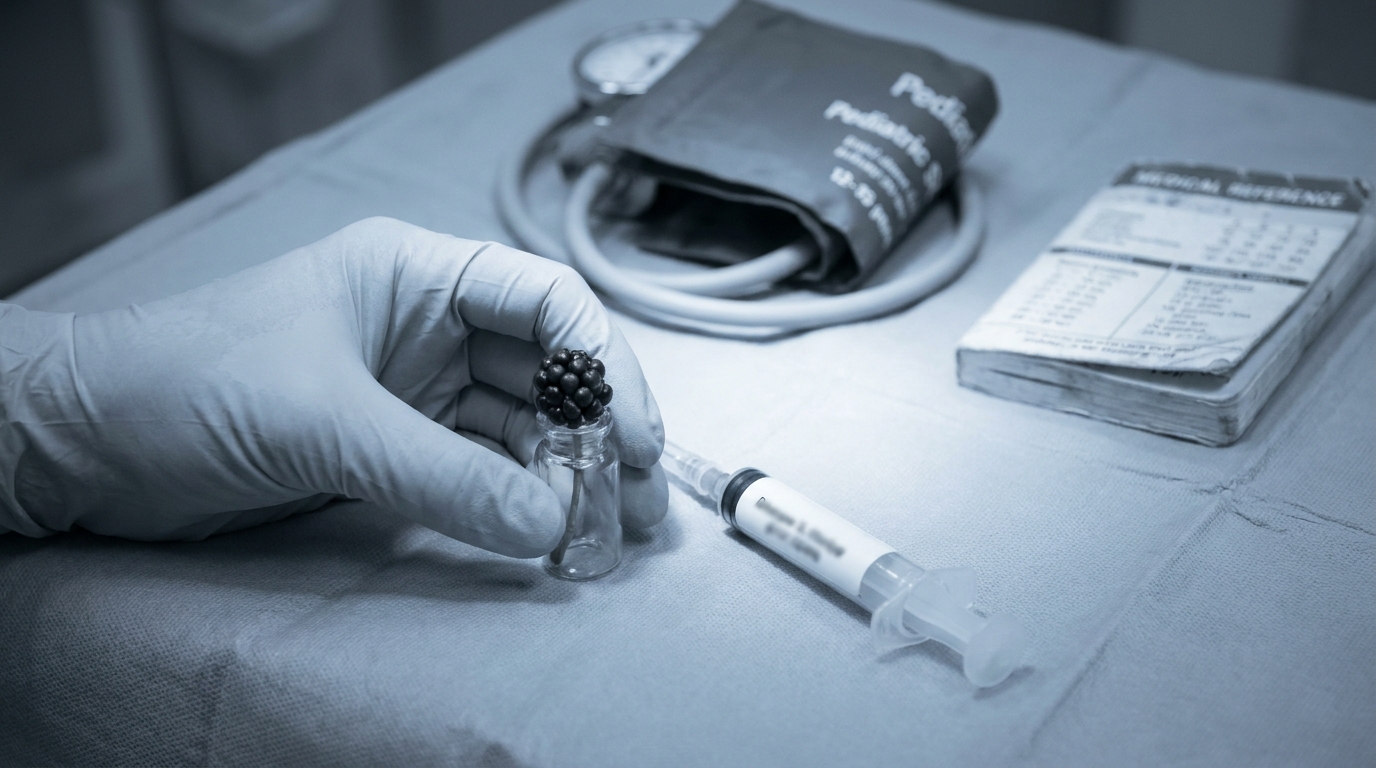
Poisonings from plants with anticholinergic effects are among the most common toxicological emergencies in childhood. Deadly nightshade (Atropa belladonna), angel's trumpet (Brugmansia spp.), jimsonweed (Datura stramonium), and henbane (Hyoscyamus niger) grow in Central European gardens, parks, and at forest edges – and their often conspicuously colored berries or flowers are particularly attractive to toddlers. As few as three to five deadly nightshade berries can cause severe poisoning in a three-year-old. Rapid recognition of the anticholinergic toxidrome, a well-founded risk assessment, and targeted therapy – including the administration of physostigmine as a specific antidote – are critical for the outcome. This article provides you with the clinical decision points, weight-based dosing, and differential diagnostic considerations you need in pediatric emergency care.
Toxicology: Which Substances Are Relevant?
The toxic compounds in the plants mentioned above are tropane alkaloids – primarily atropine (dl-hyoscyamine), scopolamine (l-hyoscine), and hyoscyamine (l-hyoscyamine). They act as competitive antagonists at muscarinic acetylcholine receptors (M1–M5), thereby blocking parasympathetic neurotransmission at:
- Smooth muscle (gastrointestinal tract, urinary bladder, bronchi)
- Exocrine glands (sweat, salivary, and lacrimal glands)
- Heart (sinoatrial node)
- Central nervous system (crosses the blood-brain barrier, particularly scopolamine)
Toxic Doses in Children
Toxicity varies considerably depending on the plant part and alkaloid content. The following reference values serve as clinical guidance:
| Plant | Toxic Plant Part | Estimated Lethal Dose (Child) |
|---|---|---|
| Deadly nightshade | Berries (approx. 1–2 mg atropine/berry) | 3–5 berries (toddler) |
| Jimsonweed | Seeds, leaves | 10–20 seeds |
| Angel's trumpet | Flowers, leaves, nectar | As little as 1 flower (brewed) |
| Henbane | Seeds, leaves | 15–20 seeds |
The pure atropine dose at which severe symptoms can be expected in children is approximately 0.02–0.05 mg/kg body weight. Lethal doses have been reported starting at approximately 0.1–0.2 mg/kg, although individual susceptibility varies considerably.
The Anticholinergic Toxidrome: Recognizing Key Symptoms
The anticholinergic syndrome is one of the classic toxidromes and can be memorized using the well-known mnemonic:
- "Blind as a bat" – mydriasis, accommodation disturbance, photophobia
- "Dry as a bone" – dry skin and mucous membranes, thirst
- "Red as a beet" – cutaneous vasodilation, flushed, warm skin
- "Hot as a hare" – hyperthermia (absent sweat secretion!)
- "Mad as a hatter" – agitation, hallucinations, delirium, seizures
- "Full as a flask" – urinary retention
- "Tachy as a fox" – sinus tachycardia
Specific Considerations in Children
Children often present with the cardinal symptoms in a different temporal sequence and severity compared to adults:
- Tachycardia is frequently the first symptom and can reach heart rates exceeding 200/min in toddlers.
- Mydriasis is a reliable finding and often persists for 24–48 hours – even in milder poisonings.
- CNS symptoms are more dominant in children: agitation, crying, visual hallucinations (the child "picks" nonexistent objects from the air), ataxia, and generalized seizures.
- Hyperthermia develops rapidly in children and is potentially life-threatening, as thermoregulation is completely abolished due to absent sweat secretion.
- Intestinal atony and urinary retention are easily overlooked in infants and toddlers.
Time Course
Symptoms typically begin 30–60 minutes after ingestion but can onset as early as 15 minutes in fasting children. Peak effects are reached after 1–4 hours. Due to the gastrointestinal atony caused by atropine, absorption can be significantly delayed – prolonged monitoring is therefore essential.
Differential Diagnosis
Not every agitated child with tachycardia has an anticholinergic toxidrome. You should systematically consider the following differential diagnoses:
- Sympathomimetic toxidrome (e.g., amphetamines, cocaine): Here you typically find sweating (moist skin!) instead of dry skin – this is the key distinguishing feature.
- Serotonin syndrome: Additionally presents with clonus, hyperreflexia, diarrhea.
- Malignant hyperthermia: History of anesthesia induction, rigidity, elevated CK.
- Meningoencephalitis: Neck stiffness, fever pattern, CSF findings.
- Febrile seizure: Typically self-limiting, no mydriasis, no dry skin.
- Psychogenic agitation/anxiety disorder: Absence of autonomic stigmata of the toxidrome.
Clinical tip: The combination of mydriasis + dry, flushed skin + tachycardia + altered mental status is pathognomonic for the anticholinergic toxidrome and allows clinical diagnosis without laboratory confirmation in the vast majority of cases.
Risk Assessment and Severity Grading
A structured severity assessment helps you with treatment planning:
Mild Poisoning
- Tachycardia (moderately elevated for age)
- Mydriasis
- Dry mucous membranes
- Mild restlessness
- Child is responsive and oriented
Moderate Poisoning
- Pronounced tachycardia (>180/min in toddlers)
- Agitation, hallucinations
- Urinary retention
- Temperature 38.0–39.5 °C
- Intestinal atony
Severe Poisoning
- Sinus tachycardia >200/min or hemodynamic instability
- Seizures
- Coma
- Hyperthermia >39.5 °C
- Rhabdomyolysis
- Respiratory failure
Emergency Management: Step by Step
Initial Measures
- ABCDE assessment following the PALS algorithm
- Monitoring: Continuous ECG, SpO₂, temperature, blood pressure measurement
- Intravenous access: Establish early – agitated children become increasingly difficult to cannulate
- Temperature management: Active cooling for hyperthermia (ice packs to groin and axillae, wet towels with fan, cold IV fluids if needed). The absence of sweat production makes evaporative cooling alone insufficient.
Decontamination
- Activated charcoal (1 g/kg body weight, maximum 50 g) can be considered within the first 1–2 hours after ingestion, provided the child is cooperative and the airway is secured.
- Caution: In already agitated or somnolent children, the aspiration risk is increased. Gastric lavage is generally not indicated in plant poisonings.
- Due to anticholinergic gastric emptying delay, activated charcoal may potentially still be effective beyond the standard time window – however, this remains a case-by-case decision.
Symptomatic Therapy
- Agitation/seizures: Benzodiazepines are the agents of choice.
- Midazolam: 0.1–0.2 mg/kg IV (maximum 5 mg), alternatively 0.2 mg/kg intranasal or buccal
- Diazepam: 0.2–0.3 mg/kg IV (maximum 10 mg)
- Lorazepam: 0.05–0.1 mg/kg IV (maximum 4 mg)
- Fluid resuscitation: Liberal isotonic crystalloid administration (0.9% NaCl or Ringer's lactate), especially in the setting of hyperthermia and absent insensible perspiration
- Urinary retention: Insert urinary catheter, determine residual volume
Physostigmine – The Specific Antidote
Physostigmine (Anticholium®) is a reversible acetylcholinesterase inhibitor that – unlike neostigmine – crosses the blood-brain barrier and thus effectively treats the central nervous system symptoms of the anticholinergic toxidrome.
Indications for Physostigmine
Not every anticholinergic poisoning requires antidote administration. The indication exists for:
- Severe agitation/delirium unresponsive to benzodiazepines
- Seizures unresponsive to benzodiazepines
- Hemodynamically significant tachycardia
- Severe hyperthermia
- Coma
Contraindications
- Cardiac conduction disturbances (AV block, wide QRS complex >100 ms)
- Concomitant ingestion of tricyclic antidepressants (risk of asystole!)
- Bronchospastic disease (relative contraindication)
- Mechanical ileus or urinary tract obstruction
Dosing in Children
| Parameter | Recommendation |
|---|---|
| Single dose | 0.02 mg/kg IV (slowly over 5 minutes) |
| Maximum single dose | 0.5 mg (children <12 years), 2 mg (adolescents) |
| Repeat | After 10–15 minutes if insufficient effect |
| Maximum total dose | 2 mg (children <12 years) |
| Infusion rate | Maximum 0.5 mg/min |
Practical approach:
- Place child on continuous ECG monitoring
- Have atropine ready as an antagonist (0.02 mg/kg, minimum 0.1 mg)
- Administer physostigmine 0.02 mg/kg slowly IV over 5 minutes
- Observe for clinical effect (decrease in tachycardia, improvement in level of consciousness, onset of salivation)
- If insufficient effect after 10–15 minutes, administer second dose
- Caution: The duration of action of physostigmine (60–90 minutes) is shorter than that of the tropane alkaloids → rebound symptoms are possible and may require repeat dosing or a continuous infusion
Side Effects of Physostigmine
Since physostigmine produces a cholinergic state, the following side effects may occur:
- Bradycardia (most common clinically relevant side effect)
- Nausea, vomiting, hypersalivation
- Bronchospasm
- Seizures (with overly rapid injection)
- In extreme cases: asystole (particularly with pre-existing conduction disturbances)
Monitoring and Duration of Observation
The duration of observation depends on severity and clinical course:
- Mild poisoning: At least 6–8 hours of clinical observation. Discharge is possible if the patient remains asymptomatic.
- Moderate to severe poisoning: Inpatient admission to a pediatric monitored unit, at least 24 hours of monitoring.
- After physostigmine administration: Close monitoring for at least 2 hours after the last dose (risk of rebound), followed by continued standard monitoring.
Follow-Up Parameters
- Heart rate (trend)
- Pupil size and reactivity (bilateral mydriasis as a clinical marker)
- Body temperature (at least hourly during hyperthermia)
- Bladder filling (clinical or ultrasound assessment)
- Level of consciousness (GCS or AVPU)
- 12-lead ECG on admission and before physostigmine administration
Involve Poison Control Centers
In every pediatric poisoning, you should contact the appropriate poison control center early. In Austria, the Vergiftungsinformationszentrale (VIZ) Wien is available 24/7 at 01 406 43 43. The experts there can assist with risk assessment based on the estimated amount ingested, help evaluate the antidote indication, and advise on unusual clinical courses.
Prevention and Parent Counseling
As a final step in patient care, counseling the parents is part of the physician's responsibility:
- Plant identification: Deadly nightshade, jimsonweed, and angel's trumpet should be removed or made inaccessible in gardens where small children play.
- Education: Children should learn not to put plant parts in their mouths. However, in children under three years of age, this is developmentally unrealistic – protection must be passive.
- Sample collection: Parents should be encouraged to keep plant remnants or vomitus to enable botanical identification.
Summary: Algorithm at a Glance
- Suspected anticholinergic poisoning → Clinical diagnosis based on toxidrome (mydriasis, dry/flushed skin, tachycardia, CNS symptoms)
- ABCDE assessment, establish monitoring
- Decontamination – consider activated charcoal (1 g/kg if time window and level of consciousness allow)
- Symptomatic therapy: Benzodiazepines for agitation/seizures, active cooling for hyperthermia, volume resuscitation
- Physostigmine for severe symptoms (0.02 mg/kg IV slowly, repeat after 10–15 min if needed)
- Monitoring for at least 6–24 hours depending on severity
- Contact poison control center
- Parent counseling and prevention
Practical Training
Managing a poisoned child requires rapid decision-making under stress – from toxidrome recognition to weight-based dose calculation to safe physostigmine administration under continuous monitoring. These workflows are most effectively trained in realistic simulation scenarios where you develop and reinforce team-based action routines. In the PALS course (Pediatric Advanced Life Support) by Simulation Tirol, you systematically practice the assessment and stabilization of critically ill children – including toxicological emergencies. The AHA-certified course formats give you the opportunity to apply algorithms under realistic conditions and strengthen your confidence for real-life emergencies.
Want to practice this hands-on?
In our PALS-Kurs (Pediatric Advanced Life Support) you practice this topic hands-on with high-tech simulators and experienced instructors.
More Articles
Epinephrine Dosing in Pediatric Resuscitation: Weight-Based Calculation
Epinephrine is the key medication in pediatric resuscitation, but weight-based dosing is a common source of error. This article explains the correct calculation (10 µg/kg), dilution steps, routes of administration, and typical dosing errors that occur under stress.
Airway Management in Neonates: Suctioning and Stimulation
When and how suctioning is indicated in neonates, tactile stimulation as the first step, and common errors in initial respiratory support. A practical guide for healthcare professionals in the delivery room and prehospital setting.
Bradycardia in Neonates: Causes and Immediate Management
Neonates and infants frequently respond to stress with bradycardia rather than tachycardia. This article explains the most common triggers (hypoxia, vagal stimulation, medications), critical heart rate thresholds, and the stepwise approach from stimulation to epinephrine administration.